Lesnewth
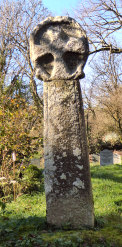
After revisiting St. Juliot's church with its Thomas Hardy associations, I went on to nearby Lesnewth. The name is a corruption of Lys Noweth or New Court. The village is but a hamlet with church, Old Rectory, Coach House, two farms and a few cottages. What I hadn't expected was to find a large Cornish Cross, its head a nicely cut wheel-cross. The church consists of three stage, pinnacled tower, nave, chancel and a vestry in the form of a double south transept. In the nave there are reported to be stained glass roundels (2003) by Caroline Henderson. I only noticed one, that of a bird on a twig, crosses on a hill in the background. On a wall an entertaining board records a grant from the "Incorporated Society for Building Churches". Elsewhere a slate memorial slab of 1680 carries an elaborate coat of arms. Pevsner says that in the porch are a Cornish wheel-head cross and a C13 grave slab with an incised foliated cross. I returned to check but I am afraid Pevsner is mistaken.
Cornish Cross
Lesnewth Church
South Transept, one half of
Photographs
More in Churches & Holy Sites
Lewannick
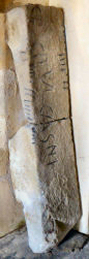
Lewannick is a fairly ordinary, but not uninteresting, little village, happily bypassed by the busy A30, just off the eastern fringes of Bodmin Moor. It has several buldings of interest including a house calling itself Lewannick Manor, but originally the Rectory; next to it a house calling itself Priory House; a former Police House, in that use from 1871 to 1950; and a pub named Archer Arms for the former local landowners. The church stands on an elevated site, presumably with an earlier non-Christian history. It consists of nave, aisles, porch and three-stage tower. The porch roof has some interesting carved bosses, including the one below right, and an old font stands there, too. The most important feature is the two inscribed stones, one in the church inscribed in ogham as well as regular script, the other south in the churchyard. There is an elaborately carved pulpit and the Norman font carries carvings of a labyrinth and two pentagrams. There is an unusual carved stone reredos and the altar is covered with a colourful cloth. A metal wall plaque carries figues of a lion and what looks like a Roman soldier.
Linkinhorne, Stoke Climsland and Lezant
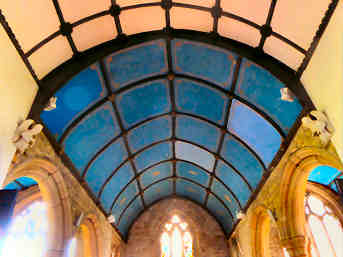
At the very end of December 2017 I made a trip down east to the general area between Launceston and Callington in order to take a look at the churches in Linkinhorne, Stoke Climsland and Lezant. I had been in the first two of these villages back in May 2007 when walking the Cornish section of the Land's End Trail heading west from the River Tamar at Horsebridge to Land's End. On this occasion I had gone to visit the churches in each village.
Liskeard, St. Martin's Church
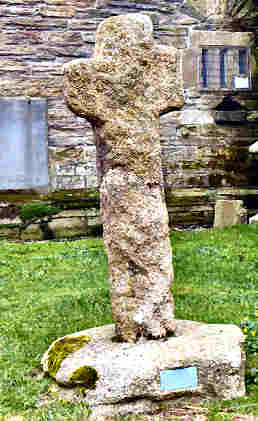
In early March 2019 I headed down east again, this time to visit St. Lalluwy's church in Menheniot village and St. Martin's church in the major town of Liskeard The most striking feature of St. Martin's is the way it stands out on its hill, south of the town centre. The next thing that strikes you is how ugly the church is on the outside, its dark stone repelling rather than enticing. Before entering do first look for the two Cornich Crosses in the churchyard: one you pass on your way from the south lych gate to the church entrance in a two-storey height porch, the other is in the graveyard on the south east side of the church. What I missed was the Consecration Crosses on the outer waslls of the north and south aisles, apparently unique in Cornwall. Except for services the church is normally locked tight so I was fortunate to arrive at the same time as a churchwarden, who not only allowed me in but also provided some helpful information, including the fact that St. Martin's is Cornwall's second largest parish church after St. Petroc's in Bodmin. The interior has a lofty and airy feel though the chancel, separated by a chancel arch, is lower than the nave. With one exception, the east window, all chancel windows are original Perpendicular. A fragment of medieval glass is displayed in a niche in the south aisle. The plain font is probably 16th century; its cover, probably Victorian, is very elaborate. In the chancel both altar and reredos are elaborate, the latter quite colourful. A royal coat of arms is of George II. The elaborate organ, its pipes colourful, is topped by a trumpeter. A nicely carved lectern stands by the quire parclose screen. The octagonal pulpit, made in 1646 by Peter Short, is beautifully carved.