John Opie (1761-1807) - Portrait painter to Georgian society
Opie (1761-1807) - Portrait painter to Georgian society
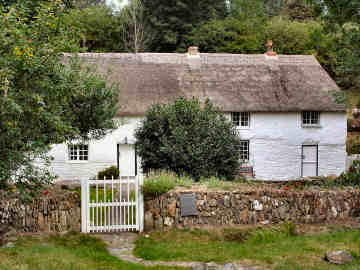
I sought out Harmony Cot, birthplace of the great Cornish portrait painter, during a walk from Trevellas Porth in August 2006. Sadly, a visit is not possible but at least a plaque on the wall outside tells you that this relatively simple cottage near Mithian was his birthplace. Sometimes the cottage is referred to as Blowing House but the lane is Blowing House Lane and I imagine the blowing house (smelter) was elsewhere. This was mining country and John's father was carpenter at a local mine, perhaps Blue Hills in Trevellas Coombe. John proved to be something of a self-taught prodigy. By the age of twelve he had not only learned to draw but had apparently mastered Euclid and was teaching writing and arithmetic - and all this while apprenticed to a wheelwright. His talent for portraiture was spotted by Truro writer Dr. John Wolcott who launched him as an artist and took him to London in 1780, where promotion as the self-taught 'Cornish Wonder' brought early success. In 1787 his historical paintings brought him membership of the Royal Academy. He lectured at the Academy and wrote a life of Joshua Reynolds, another fairly local man, born in Devon. Opie's works can be seen at the Tate Britain, in the Royal Collection, in the Royal Cornwall Museum in Truro - and in many Cornish homes.
Harmony Cot - John Opie's birthplace
Marked on OS 104 at approximately 746/515
More in Miscellanea
King Harry Ferry
Harry Ferry
Land's End - and why not to go there
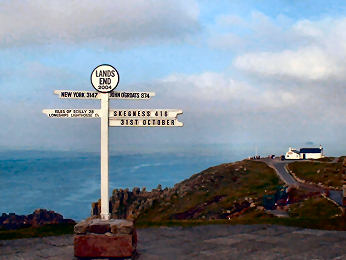
It is difficult to find words to express the shame for what has been done to Land's End. Both Jane and I remember it from our childhood as a place of magic with an end-of-the-world feeling, the only human intervention a small hotel and a tearoom. Then in 1981 Welsh entrepreneur David Goldstone outbid the National Trust for the estate. He sold on to the mysterious Peter de Savary (Skibo Castle, Bovey Castle and Caribbean resorts) in 1987. De Savary bought John o'Groats in 1989 but then got into financial trouble and sold both in 1991 to Isle of Man entrepreneur Graham Ferguson Lacey. Now the hotel has been greatly extended and vulgarised and a small and tatty theme park introduced to separate the visitor from his money. Much of the clifftop is roped off and inaccessible. Even the famed direction sign (New York 3147 miles) is subject to a fee if you want to be pictured by it. What a sad place it is! For a real end-of-the-world feeling you would do far better to go a mere five miles or so north to Cape Cornwall, which is owned by the National Trust but which, in the way of 'visitor attractions', has only the summer ice cream wagon in the car park. This is far more representative of the real Cornwall.
Landscapes of King Arthur
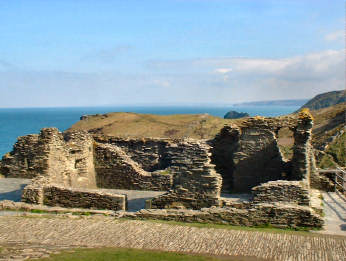
You may or not believe in King Arthur - there is no physical evidence and scant contemporary record of the British hero killed in battle around AD500 - but he has had a hold on the imagination ever since the romantic chivalric tales of the early middle ages. I choose to believe that there is no smoke without at least a hint of fire. So I like to think that there is something to the legends that locate him in Cornwall. The photo is of the medieval Great Hall on the 'Island' at Tintagel where some archaeological remains of the appropriate period are known as Arthur's Castle; the site is very steep and not for the faint hearted and there is quite a long walk down from the nearest car park. A few miles away, at Slaughterbridge near Camelford, an inscribed stone is claimed to refer to Arthur's final fateful battle of Camlaan, where he was mortally wounded by Modred. Near Wadebridge, a hill fort is named in the Welsh Mabinogion as Arthur's home 'Kelliwic'. In the middle of Bodmin Moor, near Jamaica Inn, is Dozmary Pool; here Sir Bedivere is said to have thrown Excalibur after Arthur's death. Another Dozmary Pool legend has poor Jan Tregagle condemned forever to try to empty the pool with a leaky scallop shell. Some way north of Dozmary Pool, also on Bodmin Moor, is King Arthur's Hall - there is no serious connection.