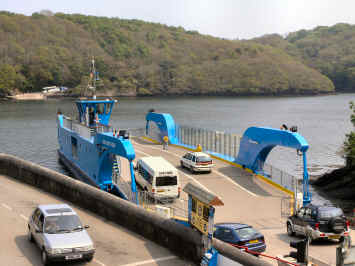
King Harry Ferry
Harry Ferry
A ferry has crossed the heavily wooded River Fal from Philleigh to Feock for at least five centuries, probably far longer than that. There are two tales about the origin of its name. One has it that King Henry VIII crossed the Fal here on his way to his honeymoon with Anne Boleyn at St. Mawes Castle. Since the marriage predated the castle, that is more than a little unlikely. The other, more likely story is that it took its name from a chapel on the Philleigh side of the River Fal dedicated to St. Mary and King Henry, this king being 15th century King Henry VI. The first steam powered chain ferry appeared in 1888 when a local company was formed to operate it. The company eventually changed hands in 2001 and is now owned by a syndicate of five Cornish families. No longer steam powered, diesel engines wind the 'floating bridge' across on massive chains. If you are driving between St. Mawes and Falmouth, this is the only way to go. You save at least half an hour and the cost of the fare is about the same as the cost of a gallon of petrol or diesel. A surprisingly realistic statue watches you from a rail high above the deck; its counterpart relaxes on a bench on the Feock side, where a path leads to Trelissick Garden; a cousin can be found outside Trelawney Centre near Wadebridge. The new blue ferry came into service in May 2006. Rather nicely, local schoolchildren were consulted about the design. Their input included the glass side and the view of the chain.
B3289 from A39 Playing Place to St. Just Lane nr St. Mawes
New King Harry Ferry crosses the River Fal
More in Miscellanea
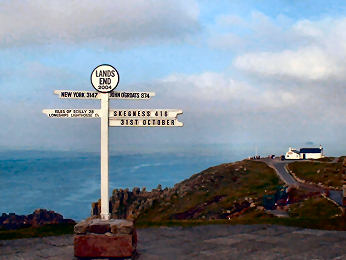
Land's End - and why not to go there
It is difficult to find words to express the shame for what has been done to Land's End. Both Jane and I remember it from our childhood as a place of magic with an end-of-the-world feeling, the only human intervention a small hotel and a tearoom. Then in 1981 Welsh entrepreneur David Goldstone outbid the National Trust for the estate. He sold on to the mysterious Peter de Savary (Skibo Castle, Bovey Castle and Caribbean resorts) in 1987. De Savary bought John o'Groats in 1989 but then got into financial trouble and sold both in 1991 to Isle of Man entrepreneur Graham Ferguson Lacey. Now the hotel has been greatly extended and vulgarised and a small and tatty theme park introduced to separate the visitor from his money. Much of the clifftop is roped off and inaccessible. Even the famed direction sign (New York 3147 miles) is subject to a fee if you want to be pictured by it. What a sad place it is! For a real end-of-the-world feeling you would do far better to go a mere five miles or so north to Cape Cornwall, which is owned by the National Trust but which, in the way of 'visitor attractions', has only the summer ice cream wagon in the car park. This is far more representative of the real Cornwall.
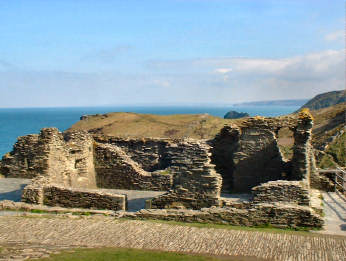
Landscapes of King Arthur
You may or not believe in King Arthur - there is no physical evidence and scant contemporary record of the British hero killed in battle around AD500 - but he has had a hold on the imagination ever since the romantic chivalric tales of the early middle ages. I choose to believe that there is no smoke without at least a hint of fire. So I like to think that there is something to the legends that locate him in Cornwall. The photo is of the medieval Great Hall on the 'Island' at Tintagel where some archaeological remains of the appropriate period are known as Arthur's Castle; the site is very steep and not for the faint hearted and there is quite a long walk down from the nearest car park. A few miles away, at Slaughterbridge near Camelford, an inscribed stone is claimed to refer to Arthur's final fateful battle of Camlaan, where he was mortally wounded by Modred. Near Wadebridge, a hill fort is named in the Welsh Mabinogion as Arthur's home 'Kelliwic'. In the middle of Bodmin Moor, near Jamaica Inn, is Dozmary Pool; here Sir Bedivere is said to have thrown Excalibur after Arthur's death. Another Dozmary Pool legend has poor Jan Tregagle condemned forever to try to empty the pool with a leaky scallop shell. Some way north of Dozmary Pool, also on Bodmin Moor, is King Arthur's Hall - there is no serious connection.
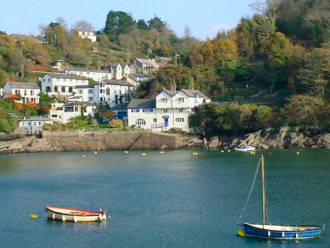
Literary Cornwall - 1 - Fowey - mostly Daphne du Maurier
Fowey is best known for its connection with Daphne du Maurier. In 1926 her parents bought 'Ferryside' at Bodinnick and she fell in love with it and Fowey. In 1932 she married Boy Browning at Lanteglos church. They lived in London but in 1943, with Boy away at war, Daphne rented a house at Readymoney Cove south of Fowey. She then persuaded local landowners, the Rashleighs (builders of Charlestown harbour), to rent her Menabilly, a mile west. Menabilly was the model for 'Manderley' in Rebecca. When her lease expired in 1969 she moved to another Rashleigh home, Kilmarth, where she died in 1989. There is a du Maurier Literary Centre shop at 5 South Street in Fowey and each May a Literary Festival honours her. Other du Maurier locations are Frenchman's Creek on the Helford River and Jamaica Inn at Bolventor. Before du Maurier, Q - Sir Arthur Quiller-Couch - was the literary lion of Fowey. Born in Bodmin and, although Professor of Literature at Jesus College Cambridge, he lived most of his life at The Haven on The Esplanade, where a plaque commemorates him; his memorial stands high on Hall Walk across the river. One of his friends and visitors was Kenneth Graham, author of Wind in the Willows; Graham was inspired by the Fowey River and Q himself - who loved 'simply messing about in boats' - is believed to have been the model for Ratty.