
The Chough - Another Emblem of Cornwall
Chough - Another Emblem of Cornwall
Along with the fisherman and the miner, the chough was the third symbol of Cornwall on the old county coat of arms. A member of the crow family, it is distinguished by its red beak and legs and by its habitat, nesting in cracks or caves on high cliffs and feeding on short clifftop pasture. Once a feature of all the western coasts of the British Isles, the chough disappeared from Cornwall around 1952. A breeding programme had been established at Paradise Park in Hayle when suddenly, in 2001, a breeding pair appeared on the Lizard. The first young were fledged in summer 2002. It seems they have spread, probably largely thanks to the National Trust which has introduced highland cattle to increase clifftop grazing and create their ideal feeding ground. Their location is around Kynance Cove but don't even think of stealing their eggs; they are guarded 24 hours a day by a dedicated team of chough watchers. I am convinced that in February 2005 I saw two pairs in the air above the cliffs during a north coast walk and heard their distinctive call. The chough is important in Cornwall for its mythological connection with King Arthur. It is said that, when Arthur was killed, his soul migrated into a chough and his blood stained its beak and legs red. It is wonderful that, after a break of more than 50 years, the chough is back in its spiritual home; long may it breed successfully in Cornwall. As for pronounciation of its name, everyone seems to calls it the chuff. However the Cornish pronunciation of ough is ow - as in Roughtor - so it should really be pronounced chow, which approximates its distinctive call.
The Chough (pronounced chow)
More in Miscellanea
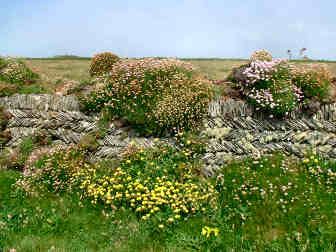
The Cornish Hedge - not quite what you might expect
Hedge - not quite what you might expect
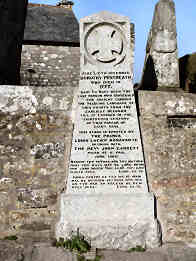
The Cornish Language
Language
The Tamar Bridges
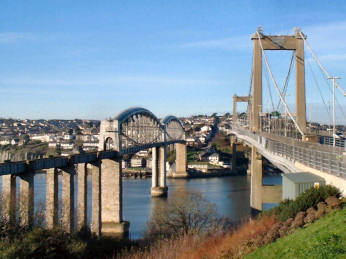
The River Tamar forms a natural barrier, and in consequence boundary, between Cornwall and England. In medieval times it was easier to sail to London than to make the journey by road. Bridges gradually got built and in 1485 New Bridge (it's still called that!) at Gunnislake provided the southernmost crossing. It was not until 1961 that the Saltash ferry, the only direct vehicle access from Plymouth, was superceded by the suspension bridge on the right of the picture. However, capable Victorian engineering had already provided a southern rail crossing. The great engineer Isambard Kingdom Brunel, builder of the first real ocean liner, the Great Britain, completed his Royal Albert Bridge in 1859. Its height was dictated by the need for large naval vessels to pass underneath with 100 feet clearance at high tide. Its construction was revolutionary: its two massive spans were pre-fabricated, floated down the river on barges and jacked up into position. Brunel demonstrated his confidence by standing on each span end as it was jacked up. The bridge was opened by Prince Albert. Sadly Brunel died shortly after. There are two contrasting viewpoints - a high level car park on the Plymouth side and the waterfront (with pubs) on the Saltash side.