The Cornish Hedge - not quite what you might expect
Hedge - not quite what you might expect
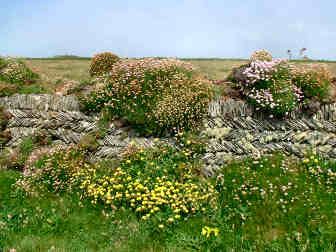
To the English a hedge is formed from small trees. To the Cornish that is a hedgerow: a Cornish hedge is an earthen bank, faced with field stone that is packed with earth. It serves three main purposes. It clears a field of rocks, it creates a barrier and a boundary, and it allows plantlife to flourish on it. North of Wadebridge and high on the moors growth may be mostly grass and furze, elsewhere a hedge may be covered with wildflowers. Hedgers all have their own styles. Some lay their stones flat, some vertical, some in elaborate curzeyway (herringbone) pattern. Character tends to differ also in North Cornwall where most of the hedges are built of slate rather than granite. When our neighbour Jim was a child, his father grew cabbages in his! If you drive in a narrow, high-banked lane, beware, the banks may well be Cornish hedges. My own most favoured colourful hedges are around Bedruthan Steps and near Kynance Cove on the Lizard but there are some superb examples between Porthreath and Gwithian and in West Penwith between St. Ives and Cape Cornwall The hedge at Bedruthan Steps runs for a couple of miles, is constructed curzeyway style (herringbone pattern) and was once quite covered with wild flowers. Sadly, when I last saw it in 2009, a stretch of it had been almost destroyed by an ignorant farm contractor. I hope it will be colourfully re-colonised soon.
Guild of Cornish Hedgers Website
Lovely 'curzeyway' hedging near Carnewas
The Guild of Cornish Hedgers has an excellent and informative web site. If you want to know more about Cornish Hedges than I shall ever know, you want to read Robin Menneer's clear and well illustrated pages on the subject.
Cornish
More in Miscellanea
The Cornish Language
Language
The Tamar Bridges
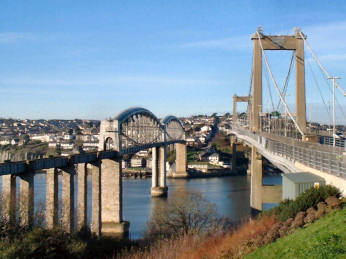
The River Tamar forms a natural barrier, and in consequence boundary, between Cornwall and England. In medieval times it was easier to sail to London than to make the journey by road. Bridges gradually got built and in 1485 New Bridge (it's still called that!) at Gunnislake provided the southernmost crossing. It was not until 1961 that the Saltash ferry, the only direct vehicle access from Plymouth, was superceded by the suspension bridge on the right of the picture. However, capable Victorian engineering had already provided a southern rail crossing. The great engineer Isambard Kingdom Brunel, builder of the first real ocean liner, the Great Britain, completed his Royal Albert Bridge in 1859. Its height was dictated by the need for large naval vessels to pass underneath with 100 feet clearance at high tide. Its construction was revolutionary: its two massive spans were pre-fabricated, floated down the river on barges and jacked up into position. Brunel demonstrated his confidence by standing on each span end as it was jacked up. The bridge was opened by Prince Albert. Sadly Brunel died shortly after. There are two contrasting viewpoints - a high level car park on the Plymouth side and the waterfront (with pubs) on the Saltash side.
Thrussell and Thrussell - Artist Metalsmiths
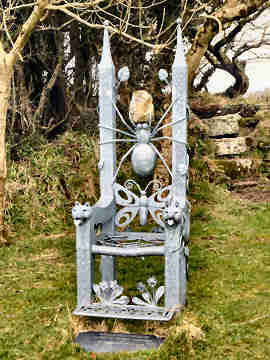
I first encountered the work of the Thrussells, father and son Gary and Thomas, in 2005 when Jane and I started walking the Clay Trails, around Bugle and Wheal Martyn. At beginning of what I like to call the White River Trail -Wheal Martyn to St, Austell and, after a gap, on to Pentewan - is a small metal chimney with cleverly cut out small individual clay country features, photo below right. My next encounter, some years later was, when doing a round walk from St. Breward, I found "Arachnathrone", photo below left, on a grassy patch between the Primary School and the path to De Lank. Then Jane and I were walking on Bodmin Beacon when we discovered Thrussell benches; how pleasing to be able to rest on the work of one's favourite artist metalsmiths. Since then we have encountered their work at two pubs, the Rann Wartha in St. Austell, below, and Weatherspoons Chapel an Gansblydhen in Bodmin, and at two more primary schools, in Pensilva and Wadebridge. A favourite motif seems to be the salmon; we particularly like the one near Wenford Dries on the northernmost section of the Camel Trail. Now that I seem to be committed to seeing all the Thrussell works that we can reach in a day, I am compiling a list of those yet to see. Already I have added the Penrice Cross at Penrice Academy in St. Austell, the Archway to the Children's Playground in Carharrack - happy memories of the Redruth and Chacewater Mining Trail.and the Bandstand in Launceston. We also found an unexpected one on the slope below the Cornwall end of Tamar Bridge. If our health and fitness hold out into 2017 we hope to cross the bridge to see their work on Plymouth Hoe and on the Plym Valley Trail. The Thrussells work is not just in Cornwall and Devon; see it also in Bilston in Staffordshire and Maldon Friars in Essex.