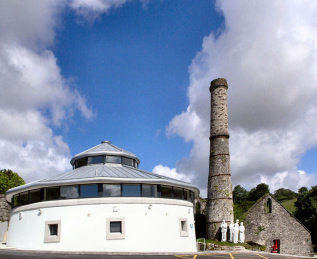
Wheal Martyn Museum of China Clay
Cornwall’s tin-mining industry may be long gone with the collapse in the price of tin but, with the demand for kaolin for porcelain, paper, medical and many other applications, china clay production continues on a large scale north of St. Austell, amidst a strange ‘Mountains of the Moon’ landscape, known locally as the Cornish Alps. Wheal Martyn, a major working clay-pit, has restored its 19th century workings to create an important museum of one of Cornwall's most enduring industries. An excellent introductory exhibition tells the story of china clay and of Wheal Martyn. Informative exhibitions include displays of minerals, examples of local pottery and porcelain, the great Fal Valley Oil Engine, displays on the local brick-making industry, on the cooper’s art and on tools and transport equipment. An Historic Trail covers the old works; along the way you see two working waterwheels, one 18 foot, the other Cornwall's largest at 35 feet, slurry pumps, settling pits, tanks and kilns. The whole process of china clay production, from quarrying to the final product, is well explained. A well waymarked Nature Trail runs for over a mile and shows how nature has colonised old workings and spoil heaps; a platform above modern Wheal Martyn pit offers views of the present industry and a panorama of the Cornish Alps. The museum is signed from the Bodmin-St. Austell road and is not far from the Eden Project. There is a shop, a good caf� and ample parking.
Entrance to Wheal Martyn China Clay Museum
B3274 at Carthew just south of Bugle. Some Clay Trails start here
UPDATE AUGUST 2010: The South West Lakes Trust: In April 2010 Wheal Martyn was acquired by the South West Lakes Trust, probably a good thing. The Trust is a charitable body that owns or manages 50 lakes in Cornwall, Devon, Somerset and Dorset. It works with such bodies as the Forestry Commission, South West Tourism and various sports organisations in the areas of leisure and water sports activities, green tourism and conservation. The list of trustees is impressive, including a former director of Imerys (the china clay people), directors from Viridor and South West Water, and the Lord Lieutenant of Cornwall. Cornish properties, owned or managed, include Argal Reservoir, Colliford Lake, Crowdy and Porth Reservoirs, Sibleyback, Stithians and Tamar Lakes Country Parks - and now Wheal Martyn. At the latter, it is thought that the Trust may develop flooded Lansalson Pit, perhaps for water sports. 2021: no news. Do take a look at swlakestrust excellent web site.
More in Museums & Galleries
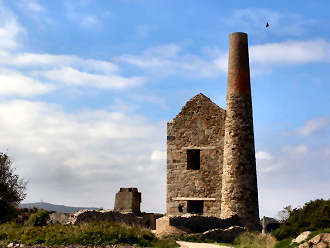
Wheal Peevor at Radnor near Redruth
Peevor at Radnor near Redruth
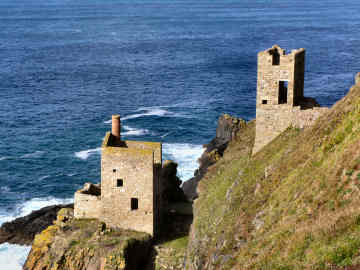
Botallack Mine
I had been here before but decided to take a closer look at the extensive remains of Botallack Mine during a walk in the area in October 2006. I parked at Pendeen Watch and then walked the coast path to Kenidjack. It is quite difficult to decide where one mine finishes and another begins - Geevor, Levant, Botallack, Wheal Edward, Kenidjack and Cape Cornwall - so closely are they packed together. Indeed, after Levant closed, Geevor, one of the last mines to work in Cornwall, and the most modern-looking along here, took over some of its extensive workings. At its most prosperous from around 1835 to 1890, Botallack was visited by Queen Victoria in 1846. In 1865 some 500 men worked there and eleven steam engines operated. Most impressively sited of these were the Crown engine houses, perched on a ledge above the sea. The lower of these housed a pumping engine, the upper was the winding engine for the 1360 foot deep Diagonal Shaft. The mine last worked in 1907-1914 when the impressive arsenic flues near the cliffs were built. A photo of the Count House, now owned by the National Trust, is in another walk I did, also in October 2006, from Pendeen Watch. There is also some 20th century headgear to be seen. If needing refreshment, try the Queen's Arms in Botallack village.

Charlestown
Charlestown may well be familiar from such TV and movies as ‘The Eagle has Landed’, ‘Poldark’, ‘The Onedin Line’ and ‘Charles Darwin’s Voyage of the Beagle’. The harbour and picturesque village were the work of engineer John Smeaton - who built the pier at St. Ives, several canals and the famous lighthouse on Eddystone Rocks, now replaced and standing on Plymouth Hoe. He built Charlestown in 1801 for local industrialist Charles Rashleigh, mainly to export the china clay from the hills above St. Austell. China clay is no longer exported from here and now the harbour is owned by a company called Square Sail who provide ships of all periods for movie-making; their small boatyards operate on the western side of the harbour and a couple of their tall ships are usually moored by the quay. Unusually for Cornwall the harbour has a sea-lock keeping it, like Padstow, in constant water. Beech trees line the approach to the village and colourful Georgian cottages line the harbour and fetch premium prices. A Shipwreck Exhibition has a vast collection of shipwreck artefacts and displays on diving and ocean liners. There are a couple of pubs; the Rashleigh Arms, on Fore Street above the harbour, is preferred. A restaurant, in a former boathouse, is open all day and serves good local produce. Charlestown gets busy, so best to avoid school holidays.