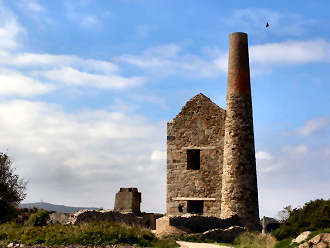
Wheal Peevor at Radnor near Redruth
Peevor at Radnor near Redruth
The conservation of Wheal Peevor, located at the hamlet of Radnor on the north side of the A30 near Redruth, is clearly one of the major enterprises of Cornwall Council's contribution to the World Mining Heritage Site. No expense has been spared in consolidating the engine houses and creating a disabled access path around the site and providing a small car park. Apparently there could also be a small visitor centre (no sign of this in 2013). In September 2007 work was not yet finished but we were lucky enough to be able to join a guided tour preview of Wheal Peevor, ably led by mining historian Allen Buckley, assisted by wldlife guide Rory Goodall. Wheal Peevor, part of the great North Downs complex, is a particularly important site because of three surviving engine houses, pumping, winding and stamps. Not only that, it also has remains of an ore crusher, buddles and an arsenic calciner - and more that will remain hidden beneath the furze and bracken. Wheal Peevor worked intermittently for a hundred years or so until around 1890, producing vast quantities of tin. It re-opened to mine wulfram in 1911 but soon closed again. We felt that restoration had been a bit overdone and, while we understand the need for access, the paths looked too much like a cycle track. And we wish the money could run to clearing furze from the lower site.
Wheal Peevor, the stamps engine house
From A30 at Redruth, take Porthtowan road, first R
I revisited Wheal Peevor in June 2008 to check on progress. Much has been done in nine months and the site is now complete. Good storyboards are located in key positions and viewing platforms are in place. In addition to the east entrance, there is also a west entrance, from a track from North Country. This is a very impressive site. My only criticism is that there are no signs from any nearby roads.
More in Museums & Galleries
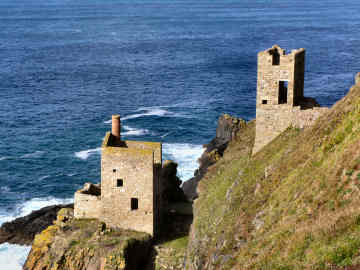
Botallack Mine
I had been here before but decided to take a closer look at the extensive remains of Botallack Mine during a walk in the area in October 2006. I parked at Pendeen Watch and then walked the coast path to Kenidjack. It is quite difficult to decide where one mine finishes and another begins - Geevor, Levant, Botallack, Wheal Edward, Kenidjack and Cape Cornwall - so closely are they packed together. Indeed, after Levant closed, Geevor, one of the last mines to work in Cornwall, and the most modern-looking along here, took over some of its extensive workings. At its most prosperous from around 1835 to 1890, Botallack was visited by Queen Victoria in 1846. In 1865 some 500 men worked there and eleven steam engines operated. Most impressively sited of these were the Crown engine houses, perched on a ledge above the sea. The lower of these housed a pumping engine, the upper was the winding engine for the 1360 foot deep Diagonal Shaft. The mine last worked in 1907-1914 when the impressive arsenic flues near the cliffs were built. A photo of the Count House, now owned by the National Trust, is in another walk I did, also in October 2006, from Pendeen Watch. There is also some 20th century headgear to be seen. If needing refreshment, try the Queen's Arms in Botallack village.

Charlestown
Charlestown may well be familiar from such TV and movies as ‘The Eagle has Landed’, ‘Poldark’, ‘The Onedin Line’ and ‘Charles Darwin’s Voyage of the Beagle’. The harbour and picturesque village were the work of engineer John Smeaton - who built the pier at St. Ives, several canals and the famous lighthouse on Eddystone Rocks, now replaced and standing on Plymouth Hoe. He built Charlestown in 1801 for local industrialist Charles Rashleigh, mainly to export the china clay from the hills above St. Austell. China clay is no longer exported from here and now the harbour is owned by a company called Square Sail who provide ships of all periods for movie-making; their small boatyards operate on the western side of the harbour and a couple of their tall ships are usually moored by the quay. Unusually for Cornwall the harbour has a sea-lock keeping it, like Padstow, in constant water. Beech trees line the approach to the village and colourful Georgian cottages line the harbour and fetch premium prices. A Shipwreck Exhibition has a vast collection of shipwreck artefacts and displays on diving and ocean liners. There are a couple of pubs; the Rashleigh Arms, on Fore Street above the harbour, is preferred. A restaurant, in a former boathouse, is open all day and serves good local produce. Charlestown gets busy, so best to avoid school holidays.
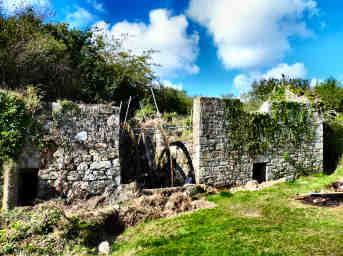
China Stone in the Tregargus Valley near St. Stephen-in-Brannel
Tregargus Valley near St. Stephen-in-Brannel