Hayle
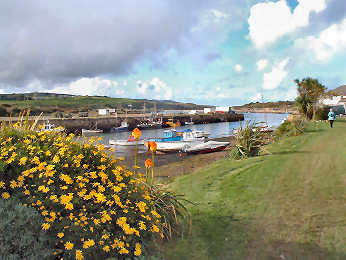
We have a soft spot for run-down places - early industrial sites and shabby towns like Bude and Portreath. Despite proximity to colourful, lively St. Ives, Hayle has something of both. It takes its name from the estuary ('heyl') on which it stands. From prehistoric days of tin and copper trading it was a trans-shipment point, providing safe passage for men and materials across the peninsula to the port at St. Michael's Mount, avoiding the perils of Land's End. In early Christian times missionaries travelled through on their way from Ireland and Wales to Brittany. There was no town until the 18th century when copper smelting and heavy engineering, later explosives manufacture on Upton Towans created a boom town. The Cornish Copper Company is long gone but there are still remnants of Harvey's great foundry that built the massive beam engines for the mines, built Richard Trevithick's steam locomotives and later built ships. Harvey's remained in business well into the 20th century and Hayle continued as a port until the 1970s when the power station closed. The derelict former foundry buildings are now the centrepiece of a vast regeneration project going on in Hayle. In addition to the foundry, financial multi-national ING plans to regenerate the harbour area. King George V Memorial Walk, on the north side of Copperhouse Pool, has been colourfully restored. Walk to the head of North Quay to enjoy views of sweeping beaches, tall dunes, holiday shacks, St. Ives and Godrevy Lighthouse.
Hayle, looking across Inner Harbour to South Quay
Signed from A30, 5 miles west of Camborne
More in Towns & Villages

Helland and Helland Bridge
It was a dull Saturday at the very end of September. I had been planning to travel down west to Penzance, to find the Cornish Cross in Morrab Gardens, but decided not to take a chance on the forecast rain but to give myself a shorter journey - to Helland, just off the Washaway - Camelford road. It was as well that I did; by the time I left Helland the rain had started. I went first to Helland village, where the church, Old Rectory and cottages stand on a hill. The Old Rectory and Churchtown Cottages were attractive, the latter best seen from inside the churchyard. As so often, the church was closed so I rely on Pevsner but in vain. All he has to say refers to a medievaL font and a 16th century grave slab. I then headed down to Helland Bridge, where a 4-arch, 15th century bridge described by Pevsner as "one of the best in the county", crosses the River Camel. A little way up the hill towards Helland village the Camel Trail crosses the road, on either side of it attractive cottages, Cobblers and Silverstream. A little down the hill is the old forge, now a home with a couple of unusual roof-lights, and across the road a stile into the grounds of Riversmead, home to Studio Potter Paul Jackson. There is little on the other side of the bridge, except the old Mill House and a couple of fairly attractive cottages.
Helston
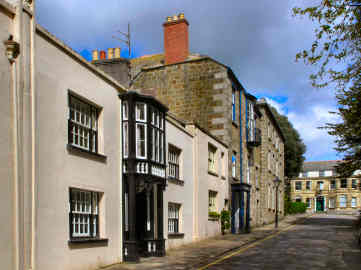
I had been wanting to get to know Helston better for some time so, when Jane and I revisited Godolphin House in April 2007, we took the opportunity to have a wander around the town. Most people really only know Helston for its Flora Day when in May the whole town takes to the streets to celebrate spring with the ritual Furry Dance. There is a lot more to Helston than that - though, while I enjoyed the town's history and architecture, Jane disliked its shops and steep streets. Helston no longer has its former importance. In medieval times it was a stannary town, exporting tin from its own port. A 12th century castle guarded the crossing of the River Cober. But the port was lost when Loe Bar blocked the river mouth, the castle fell into disuse and was demolished, and the tin industry declined. What remains is a legacy of fine buildings. To enjoy Helston's architecture, call into the Guildhall and pick up the excellent Town Trail guide, hot on history. Best streets are broad, steep Coinagehall Street, winding Church Street and Cross Street with its handsome houses. Important buildings are the classical Guildhall, the Market House (now a folk museum), the Angel Hotel (once the town house of the Godolphins), the Great Office on Cross Street, Godolphin Hall, the Grylls Monument and the former prison. There is a large free car park just down the Porthleven road; opposite, at the top of the boating lake in Coronation Park, is the excellent Lakeside caf�.

Herodsfoot
The small village, four miles south-west of Liskeard, nestles in a wooded valley. Oddly, its church and the former rectory are up a steep hill well above the village with nothing else near. The little River West Looe runs through the village. The name derives from the Cornish Hiriard, meaning long ridge, with the village at its foot. This was mining territory and had its heyday in mid to late nineteenth century, when considerable quantities of lead and silver were mined. There are still the remains of mine chimneys, engine houses and mine workings from the four mines that were active in the vicinity of the village. The Herodsfoot mines were renowned world-wide for examples of two minerals, bournonite (lead, copper and antimony) and tetrahedrite, a sulphide of copper, iron, and antimony. Gunpowder was manufactured at the Herodsfoot Powder Mill, up the valley to the west of the village, and the site was used by the explosives industry until the mid 1960s. Near the old Powder Mill Pond is the Powder Mill itself, externally surprisingly complete; the wheel-pit is alongside but there is only a hint of the old water wheel. John Betjeman, in his "Shell Guide to Cornwall" described Herodsfoot as "an inland Polperro in a deeply wooded valley. Known as a "Thankful" village, it is one of a handful of such villages in the country in which everyone who went to World War I came back. A War Memorial in the centre of the village remembers "those who served". To find the Powder Mill, take the lane west out of the village and climb the hill to bear right downhill into the Forestry Commission's "Deer Park Forest." At the bottom, the mill pond is to your left, the old Powder Mill to your right. There is a car park and refreshments. Modern holiday cabins on stilts look quite interesting. On my way leaving Herodsfoot, on a steep lane heading towards Trevelmond, I pulled in opposite Rose Cottage and got a good view to the south of Herodsfoot Mine chimney, standing firm but forlorn amongst the trees.