Helston
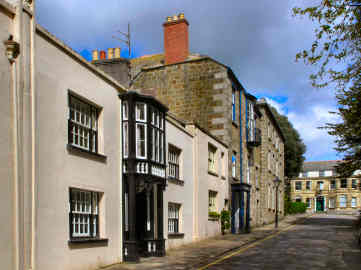
I had been wanting to get to know Helston better for some time so, when Jane and I revisited Godolphin House in April 2007, we took the opportunity to have a wander around the town. Most people really only know Helston for its Flora Day when in May the whole town takes to the streets to celebrate spring with the ritual Furry Dance. There is a lot more to Helston than that - though, while I enjoyed the town's history and architecture, Jane disliked its shops and steep streets. Helston no longer has its former importance. In medieval times it was a stannary town, exporting tin from its own port. A 12th century castle guarded the crossing of the River Cober. But the port was lost when Loe Bar blocked the river mouth, the castle fell into disuse and was demolished, and the tin industry declined. What remains is a legacy of fine buildings. To enjoy Helston's architecture, call into the Guildhall and pick up the excellent Town Trail guide, hot on history. Best streets are broad, steep Coinagehall Street, winding Church Street and Cross Street with its handsome houses. Important buildings are the classical Guildhall, the Market House (now a folk museum), the Angel Hotel (once the town house of the Godolphins), the Great Office on Cross Street, Godolphin Hall, the Grylls Monument and the former prison. There is a large free car park just down the Porthleven road; opposite, at the top of the boating lake in Coronation Park, is the excellent Lakeside caf�.
Cross Street, off Church Street near the church
On A394, twixt Falmouth and Penzance. Helston Revisited
A FAVOURITE WALK: We like to park in the large free car park at the Helston end of Porthleven Road and enjoy a coffee at the excellent caf� by the boating lake in Coronation Park before setting off on this short walk through the Penrose estate to Porthleven. We prefer to follow the track (the old carriage drive) along the shorter western side of The Loe, passing Penrose House on the way to Bar Lodge. From here we simply follow the coast path west into Porthleven, then get the bus from the head of the harbour back to Helston. The walk is a mere 3� miles. If you prefer to take the longer east side of The Loe the walk would be about 5� miles. Buses from Porthleven go hourly so lunch in Porthleven if the wait allows, or back at the Lakeside caf� if it doesn't.
In mid- February 2017 I returned to The Lizard, primarily to take a look at the Daffodil Festival at Mawgan--in-Meneage. First, however, I took another look at Helston, parking in Parc Eglos, not far from St. Michael's Church. I had really come to find two Cornish Crosses, so I headed first for the one on Cross Street, a lovely street with some fine buildings in it. I particularly like the doorway to a house called "Great Office", pictured below right. I then walked back up the hill - Helston is very much a town of hills - to St. Michael's Church, where I found another Cornish Cross on a grave near the tower. From a distance the church looks conventional enough so it is something of a surprise to enter and discover a Georgian interior. The church was built for the Earl of Godolphin between 1751 and 1761. The interior is dominated by an elaborate balcony and an unusual ceiling with elaborate coving. There is an unusual and attrective font. Memorials include a marble one to George Simon Borlase and a small War Memorial Chapel. In the large graveyard, filled with spring flowers when I saw it in late February 2017, is an elaborate memorial to Henry Trengrouse, so moved by the fate of HMS Anson that he devised his "Rocket" apparatus, precursor of the breeches buoy.
Cornish Cross on Cross Street
Unexpected Interior of St. Michael's Church
Great Office Doorway
Photographs
More in Towns & Villages

Herodsfoot
The small village, four miles south-west of Liskeard, nestles in a wooded valley. Oddly, its church and the former rectory are up a steep hill well above the village with nothing else near. The little River West Looe runs through the village. The name derives from the Cornish Hiriard, meaning long ridge, with the village at its foot. This was mining territory and had its heyday in mid to late nineteenth century, when considerable quantities of lead and silver were mined. There are still the remains of mine chimneys, engine houses and mine workings from the four mines that were active in the vicinity of the village. The Herodsfoot mines were renowned world-wide for examples of two minerals, bournonite (lead, copper and antimony) and tetrahedrite, a sulphide of copper, iron, and antimony. Gunpowder was manufactured at the Herodsfoot Powder Mill, up the valley to the west of the village, and the site was used by the explosives industry until the mid 1960s. Near the old Powder Mill Pond is the Powder Mill itself, externally surprisingly complete; the wheel-pit is alongside but there is only a hint of the old water wheel. John Betjeman, in his "Shell Guide to Cornwall" described Herodsfoot as "an inland Polperro in a deeply wooded valley. Known as a "Thankful" village, it is one of a handful of such villages in the country in which everyone who went to World War I came back. A War Memorial in the centre of the village remembers "those who served". To find the Powder Mill, take the lane west out of the village and climb the hill to bear right downhill into the Forestry Commission's "Deer Park Forest." At the bottom, the mill pond is to your left, the old Powder Mill to your right. There is a car park and refreshments. Modern holiday cabins on stilts look quite interesting. On my way leaving Herodsfoot, on a steep lane heading towards Trevelmond, I pulled in opposite Rose Cottage and got a good view to the south of Herodsfoot Mine chimney, standing firm but forlorn amongst the trees.
Hotels
: 2013 - improving. Hebasca is a boutique hotel in the modern style. The Beach describes itself as 'Luxury Hotel' and looks good.
Kilkhampton
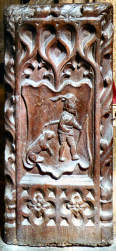
I had been in Kilkhampton previously but mostly just passing through and once to seek out the remains of a Norman motte-and-bailey castle, down the lane towards Stibb and the Combe Valley. On this occasion, in late August 2016, I was visiting three villages and their churches, the others being nearby Poughill and Stratton. Kilkhampton is a largish village, strung long the A39 north of Bude, with a few shops and a couple of pubs, The London Inn and the New Inn. I enjoyed a bacon roll and a coffee in the latter. In the small square, a war memorial commemorates Lt. Colonel Algernon Carteret Thynne DSO, killed in the Great War. The church is typically Cornish, with nave, two aisles and a battlemented and pinnacled three stage tower. Above the tower door stands a small statue, presumably of dedicatee St. James. The porch has a remarkable feature, a deeply and elaborately carved Norman doorway. Inside are three wagon roofs, higher than is usual in Cornwall, Granville memorials and a coat of arms by a pupil of Grinling Gibbons, and a superb collection of original bench ends.