
Herodsfoot
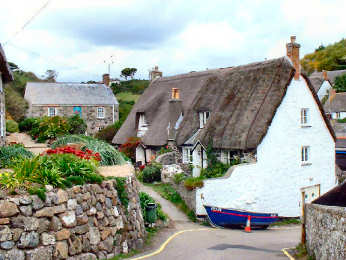
The small village, four miles south-west of Liskeard, nestles in a wooded valley. Oddly, its church and the former rectory are up a steep hill well above the village with nothing else near. The little River West Looe runs through the village. The name derives from the Cornish Hiriard, meaning long ridge, with the village at its foot. This was mining territory and had its heyday in mid to late nineteenth century, when considerable quantities of lead and silver were mined. There are still the remains of mine chimneys, engine houses and mine workings from the four mines that were active in the vicinity of the village. The Herodsfoot mines were renowned world-wide for examples of two minerals, bournonite (lead, copper and antimony) and tetrahedrite, a sulphide of copper, iron, and antimony. Gunpowder was manufactured at the Herodsfoot Powder Mill, up the valley to the west of the village, and the site was used by the explosives industry until the mid 1960s. Near the old Powder Mill Pond is the Powder Mill itself, externally surprisingly complete; the wheel-pit is alongside but there is only a hint of the old water wheel. John Betjeman, in his "Shell Guide to Cornwall" described Herodsfoot as "an inland Polperro in a deeply wooded valley. Known as a "Thankful" village, it is one of a handful of such villages in the country in which everyone who went to World War I came back. A War Memorial in the centre of the village remembers "those who served". To find the Powder Mill, take the lane west out of the village and climb the hill to bear right downhill into the Forestry Commission's "Deer Park Forest." At the bottom, the mill pond is to your left, the old Powder Mill to your right. There is a car park and refreshments. Modern holiday cabins on stilts look quite interesting. On my way leaving Herodsfoot, on a steep lane heading towards Trevelmond, I pulled in opposite Rose Cottage and got a good view to the south of Herodsfoot Mine chimney, standing firm but forlorn amongst the trees.
Thankful villages: These are the villages which suffered no losses in World War I. Among 16,000 villages in England, Arthur Mee estimated that there were at most 32 Thankful Villages, although he could only positively identify 24. A Doubly Thankful village is one which lost no-one in either World War.
Herodsfoot Thankful Village
Herodsfoot Church
Herodsfoot Powder Mill
Photographs
More in Towns & Villages
Hotels
: 2013 - improving. Hebasca is a boutique hotel in the modern style. The Beach describes itself as 'Luxury Hotel' and looks good.
Kilkhampton
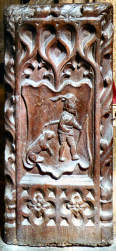
I had been in Kilkhampton previously but mostly just passing through and once to seek out the remains of a Norman motte-and-bailey castle, down the lane towards Stibb and the Combe Valley. On this occasion, in late August 2016, I was visiting three villages and their churches, the others being nearby Poughill and Stratton. Kilkhampton is a largish village, strung long the A39 north of Bude, with a few shops and a couple of pubs, The London Inn and the New Inn. I enjoyed a bacon roll and a coffee in the latter. In the small square, a war memorial commemorates Lt. Colonel Algernon Carteret Thynne DSO, killed in the Great War. The church is typically Cornish, with nave, two aisles and a battlemented and pinnacled three stage tower. Above the tower door stands a small statue, presumably of dedicatee St. James. The porch has a remarkable feature, a deeply and elaborately carved Norman doorway. Inside are three wagon roofs, higher than is usual in Cornwall, Granville memorials and a coat of arms by a pupil of Grinling Gibbons, and a superb collection of original bench ends.
Kingsand and Cawsand
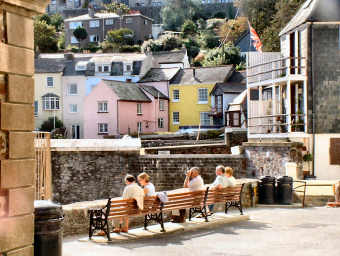
This is a charming, tucked away part of Cornwall, more easily accessed by car ferry across the Tamar to Torpoint or by foot ferry from Plymouth to Cremyll than from most of Cornwall. Here on the very south-eastern tip of Cornwall, the twin villages of Kingsand and Cawsand tumble down their hillsides to meet at small harbours facing broad Plymouth Sound with long views of Drake’s Island and the Devon coast. Where they meet at the bottom is the Halfway House Inn, a comfortable pub with a good welcome, a good atmosphere and excellent food. Rather surprisingly, until 1830 the Halfway House stood at a county boundary; Kingsand was in Devon, Cawsand in Cornwall. This is a great place to explore on foot with steep streets filled with colour washed stone cottages, jostling for space. Climb high above the Cawsand side to find an old fort, converted to housing with breathtaking views. Climb above the Kingsand side, past a tiny village green, to find a gate near the cliff that leads into glorious Mount Edgcumbe Park with its house with formal garden and Earl's Garden. There is more good walking around Rame Head to the south. There is a smallish car park next to the Halfway House and a much larger one above Cawsand.