
Landewednack
Down the hill is Church Cove, not to be confused with Gunwalloe Church Cove on the Lizard's west coast. Here the buildings in the cove make a delightful grouping: the old Fish Cellars, an attached Roundhouse, the former Winch House and the old Lifeboat House. It must have been difficult enough to launch cove boats from here, the lifeboat must have been almost impossible. All these buildings are now holiday or second homes. Up the hill is the village and church. The village is attractive with several thatched cottages and a barn with an octagonal extension. As at Gunwalloe, the church is dedicated to St. Winwaloe. He was also known as Wednack and a church at Towednack near St. Ives is also dedicated to him, as is one at Poundstock near Bude. As at Cury, the possibly 13th century church porch is remarkable, like a small chapel with an elaborate doorway. Inside are attractive barrel-vaulted ceilings, a font and lectern both using serpentine stone, a badly worn carving of two men holding a shield, colourful organ pipes, a probable cross base built into a wall, a priest's chair tucked into a squint, and a 15th century font, its donor's name inscribed on it.
Elaborate Vaulted Porch
Landewednack Church
Serpentine Pulpit
Photographs
More in Towns & Villages
Lanivet
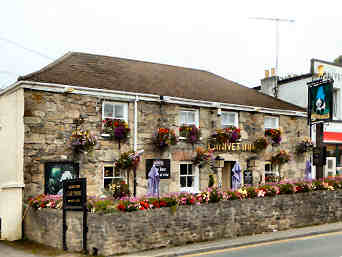
A small roadside village on the A389. I visited Lanivet in mid August 2016, on a day which included also Bodwen, Lanlivery and Luxulyan. On the road you scarcely have time to notice anything before you are out the other side. On foot there is plenty of interest. In the village itself is the pleasant Lanivet Inn which, at lunchtime does a wide range of simple, reasonably priced food, the excellent Welcome Stranger Fish and Chip restaurant opposite, a couple of small busineses, a free car park and public toilets. Walk up the turning alongside the pub and you come to the church, a handsome, typically Cornish, 15th century church in the Decorated style, ruined by improvement by Victorians, who scraped many frescoes and removed original stained glass. The reason to visit Lanivet church is the superb collection of stonework dotted around inside and out. By the porch is a 10th century 'hogback' tomb slab. Behind the church are a 13th century four-hole Cornish cross and a 10th century wheel cross. Inside the church are some fascinating memorials. One from the 5th or 6th century commemorates 'Annicu'. A portrait tomb slab in the vestry to a Courtney (perhaps related to the Earls of Devon) dates from 1560; another Courtney was added to it in 1632. A nearby tomb slab has gilded angels. Pulpit and reredos are Victorian but attractive.
Lanlivery
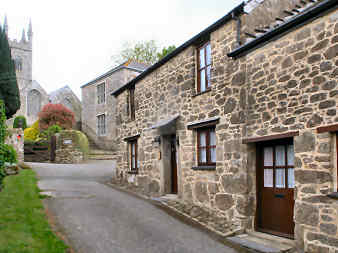
Easily missed, unless you are walking the Saints Way or looking for a good pub, Lanlivery is a charming backwater on the road to almost nowhere. I found it when I sought out the excellent Crown Inn for some of my American visitors to lunch, in the days when I was still touring. Jane and I have enjoyed lunch there since. You would never guess it now but during the 19th century the extensive, largely moorland, parish was heavily industrialised with tin mining, granite quarrying and even some china clay extraction. The population approached the 2000 mark then; now it is around 500 and would be less were it not for the second homes and holiday rentals. The church, originally dedicated to St. Dunstan, is now dedicated to St. Brevita. Her holy well is in the grounds of Churchtown, part of the Vitalise charity and providing a rural activity centre for the disadvantaged. Restored in 1993, the church is of relatively little interest, though it has some good memorials. Far more interesting is the steep little street that runs down from the back of the churchyard. The attractive Village Hall dates from the 18th century, was first a 'Dame School', later a library. Below that is the former smithy, now a home, and other attractive houses. What appears to be the Crown's car park is, I think public. The uninspiring church had, when I was there, some interesting wood carvings on window ledges.
Lanreath
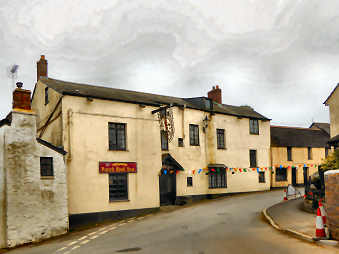
In early September I visited the village of Lanreath, abour five miles north-west of Looe. My primary purpose was to look at the church, of which more later, and to take a look at Court Barton, once the manor house of the Grylls family, now just a farmhouse. Happily there is a good sized car park by the village stores and post office - what a lucky village, still to have that alive and kicking. Sadly, the same could not be said for the Punchbowl Inn which closed in 2011 and looks very much like staying closed. But do look out for its entertaining inn sign, presumably made by a local blacksmith. Court Barton is a handsome, symetrically fronted early Jacobean house with some massive stone barns. St. Marnarch's church, its exterior essentially Perpendicular in style and well restored in 1887, consists of nave, south aisle, north transept and three stage tower. On your way in, do note the carved roof bosses in the porch. Inside are more roof bosses and two painted ceilings. A highly decorated font has an unusual octagonal cover. A board on one wall refers to Charles I as 'Prince' - in 1635! Another carries Charles II's coat of arms. The finely carved rood screen retains some medieval paintwork; in front of it is a carved Jacobean pulpit and lectern. A wall monument commemorates Charles Grylls and his wife. There is a colourful modern altar cloth. (July 2020, Punchbowl appears empty, fopr sale)