Lanlivery
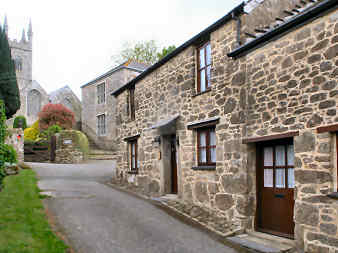
Easily missed, unless you are walking the Saints Way or looking for a good pub, Lanlivery is a charming backwater on the road to almost nowhere. I found it when I sought out the excellent Crown Inn for some of my American visitors to lunch, in the days when I was still touring. Jane and I have enjoyed lunch there since. You would never guess it now but during the 19th century the extensive, largely moorland, parish was heavily industrialised with tin mining, granite quarrying and even some china clay extraction. The population approached the 2000 mark then; now it is around 500 and would be less were it not for the second homes and holiday rentals. The church, originally dedicated to St. Dunstan, is now dedicated to St. Brevita. Her holy well is in the grounds of Churchtown, part of the Vitalise charity and providing a rural activity centre for the disadvantaged. Restored in 1993, the church is of relatively little interest, though it has some good memorials. Far more interesting is the steep little street that runs down from the back of the churchyard. The attractive Village Hall dates from the 18th century, was first a 'Dame School', later a library. Below that is the former smithy, now a home, and other attractive houses. What appears to be the Crown's car park is, I think public. The uninspiring church had, when I was there, some interesting wood carvings on window ledges.
Signed off A390, just west of Lostwithiel
Church, Village Hall and the Old Smithy
More in Towns & Villages
Lanreath
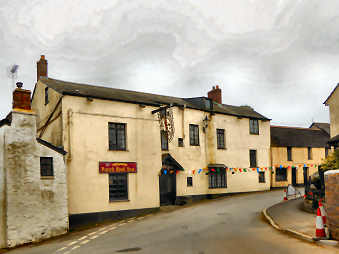
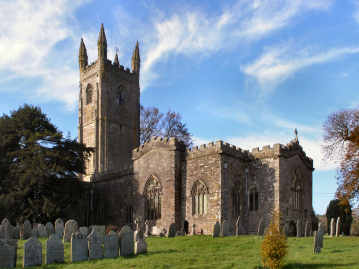
In early September I visited the village of Lanreath, abour five miles north-west of Looe. My primary purpose was to look at the church, of which more later, and to take a look at Court Barton, once the manor house of the Grylls family, now just a farmhouse. Happily there is a good sized car park by the village stores and post office - what a lucky village, still to have that alive and kicking. Sadly, the same could not be said for the Punchbowl Inn which closed in 2011 and looks very much like staying closed. But do look out for its entertaining inn sign, presumably made by a local blacksmith. Court Barton is a handsome, symetrically fronted early Jacobean house with some massive stone barns. St. Marnarch's church, its exterior essentially Perpendicular in style and well restored in 1887, consists of nave, south aisle, north transept and three stage tower. On your way in, do note the carved roof bosses in the porch. Inside are more roof bosses and two painted ceilings. A highly decorated font has an unusual octagonal cover. A board on one wall refers to Charles I as 'Prince' - in 1635! Another carries Charles II's coat of arms. The finely carved rood screen retains some medieval paintwork; in front of it is a carved Jacobean pulpit and lectern. A wall monument commemorates Charles Grylls and his wife. There is a colourful modern altar cloth. (July 2020, Punchbowl appears empty, fopr sale)
Launceston
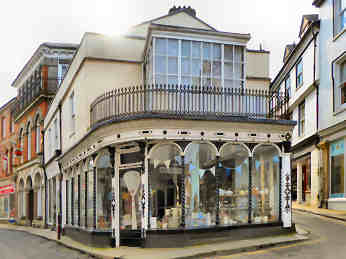
My earliest memories of Launceston are of an ordinary little town with a terrible traffic problem. That was in the 1950s when there were no decent roads into Cornwall. Now that the A30 bypasses the town, Launceston has regained the character it had before traffic congealed its arteries. We have visited twice recently - once for antiques (there are none that we could find) and then for quilting exhibitions. The quilts were wonderful - in St. Mary's church and at Cowslip Workshops at a nearby farm on the road from Egloskerry. Jo Colwill started Cowslip Workshops when foot-and-mouth had reduced farm income to zero. You can now learn sewing, quilting, embroidery, drawing and more and there is a shop, a restaurant and a gallery with good exhibitions. Launceston itself may lack good shops but it does not lack interest. The original settlement north of the river, now known as St. Stephens, has a fine church. In medieval Launceston you will find a ruined late Norman and 13th century castle, a 13th century town gate (the town walls are long gone), some handsome churches, notably that dedicated to St. Mary Magdalene, a good local museum in the National Trust's Lawrence House and a narrow gauge steam railway with its own museum. We were pleased to find Launceston much better than expected. Launceston re-visited 2016
Launceston revisited in February 2016
revisited in February 2016