Launceston revisited in February 2016
revisited in February 2016
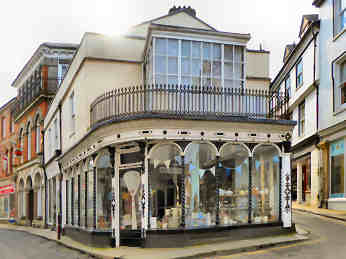
I was back in Launceston in late February 2016. First I drove down to the River Kensey and parked there in the hope of seeing the inside of St. Thomas church. That was closed but the gate to the priory ruins was open. Not that there is much to see, only a small part of the priory survives and that only to the height of less than a couple of feet. There is however a good view of the castle keep on its hilltop. On the way round to the priory ruins, I spotted the base of a massive pillar, presumably from the priory, on it an unexpected Cornish Cross. I would have liked to have looked round the old railway station, from which steam trains run to New Mills, but I was too early in the season for the Launceston Steam Railway. I then headed up the hill to the town centre and parked in a handy multi-storey car park. First I visited St. Mary Magdalen church and got some good interior photos. Among the impressive features are a fine rood screen, a lovely pulpit and good bench ends. But the exterior is the star with its intricate stone carving. Sir Henry Trecarrell is believed to have been responsible for the church's design and construction. But what struck me most about the town was the remarkable number of attractive original shop fronts. That in the photo is probably the best with its barley-sugar twist columns.
One of Launceston's many fine shop fronts
More in Towns & Villages
Lelant
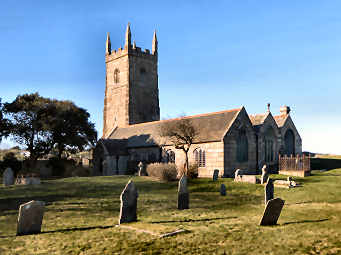
In January 2017 I had an expedition down west. First I went to see Towednack church, closed when I was there recently but happily open this time. Then I continued to Lelant where a little research in Langdon had suggested the existence of several Cornish Crosses. I checked on Cornwall Council's excellent Mapping Website and was able to confirm that I should find crosses in the churchyard of St.Uny Lelant, in the large cemetery and even on the main street. Previously I had only been in Lelant when on the Cornish Coast Path between Hayle and St. Ives. On that occasion I had taken the path between the church and its separate cemetery and not lingered at he church. On this occasion I stopped in the town first where, opposite the Badger Inn (formerly the Praed Arms) a Cornish Cross had been built into the wall next to Cross Cottage. There is now a War Memorial on the site but it looks as if the cross head is mounted on top of the memorial. In the cemetery I found 3 crosses; in the churchyard I found a further 2. The church is delightfully situated, next to a golf course and overlooking Hayle and the Hayle Estuary. Of interest in the church are 2 ancient slate memorials, an octagonal font, panelling from a medieval screen and a good reredos.
Lerryn
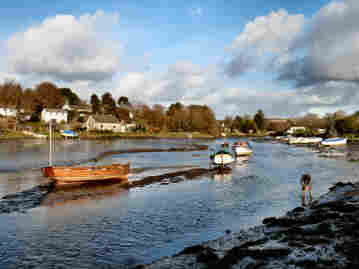
Although Lerryn in only 3 miles from Lostwithiel, and that seems the obvious way to approach it, I think that probably the best and most interesting way to approach the village is to start from Fowey and and take the Bodinnick Ferry across the Fowey River. This way not only will you have a good view of Daphne Du Maurier's parents' Ferryside home, but you will then travel along quiet lanes and through the charming hamlet of Lower Penpoll. Lerryn is clearly a wealthy little village. A number of handsome homes stand along both sides of the little River Lerryn, a tributary of the Fowey River. It is effectively a tidal creek, crossed by a medieval bridge and by stepping stones at low tide. Small boats line the river but don't move often - the very tidal nature of the river is quite restrictive. Signs of former industry include lime kilns built into homes and a former barn (maybe a warehouse) by the river. There is a lovely walk along the north side of the river to the tiny hamlet of St. Winnow. Try this walk in spring when the woodland is filled with bluebells and wild garlic. You can make a round walk of it by returning across fields to Winnow Mill, then through the National Trust's Ethy estate. We have enjoyed several good meals in the Ship Inn at Lerryn. There is a small amount of parking by the river, close to the Ship Inn.
Lewannick
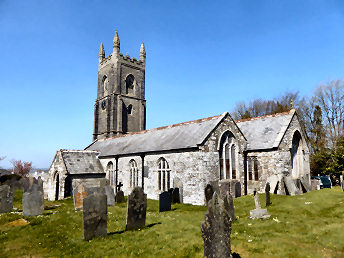
The village of Lewannick is about as far east as you can get in Cornwall, just off the fast A30 road and a couple of miles south-west of Launceston. I was there for the first time in April 2017, on a sunny Saturday. It is one of those relatively unusual Cornish villages where the church stands on a island of raised ground, six feet or so above the triangle of surrounding roads. I visited primarily to see two inscribed stones. One, inscribed in Latin and Ogham is in the church, the other is in the churchyard, south of the church. In the church porch, look up to see some unusual roof bosses. Inside are two fonts, one of unusual design with eight receptacles for water and a separate plinth, a carved wood pulpit, a carved stone reredos, and an unusual war memorial screen with painted panels. The chancel has a wagon roof with carved bosses. On the triangle of streets around the church are a pub, the Archer Arms, a former Police House of 1871, attractive Priory House (was there a priory here?) and, partly hidden down its driveway, the manor house.