Lewannick
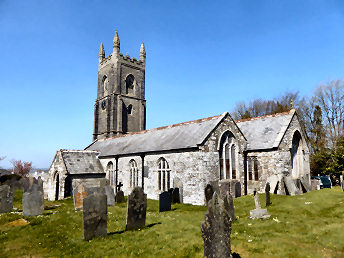
The village of Lewannick is about as far east as you can get in Cornwall, just off the fast A30 road and a couple of miles south-west of Launceston. I was there for the first time in April 2017, on a sunny Saturday. It is one of those relatively unusual Cornish villages where the church stands on a island of raised ground, six feet or so above the triangle of surrounding roads. I visited primarily to see two inscribed stones. One, inscribed in Latin and Ogham is in the church, the other is in the churchyard, south of the church. In the church porch, look up to see some unusual roof bosses. Inside are two fonts, one of unusual design with eight receptacles for water and a separate plinth, a carved wood pulpit, a carved stone reredos, and an unusual war memorial screen with painted panels. The chancel has a wagon roof with carved bosses. On the triangle of streets around the church are a pub, the Archer Arms, a former Police House of 1871, attractive Priory House (was there a priory here?) and, partly hidden down its driveway, the manor house.
Lewannick Church
Porch Ceiling Boss
Inscribed
Stone
Photographs
More in Towns & Villages

Linkinhorne and Stoke Climsland
Climsland
Liskeard
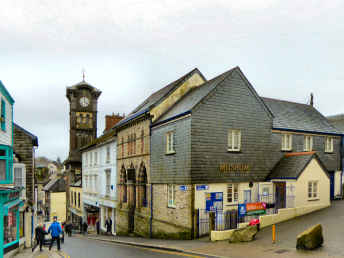
Liskeard is an odd town. First impressions were of dull, boring, mainly Victorian architecture, though I must confess that I visited on a dull rainy February 2016 day on which the dark stone of so many buildings left a dull, uninteresting impression. Previously I had only been in Liskeard (Cornish Lyskerrys, Kerywyd’s Court) on two occasions, once just passing through, on the other seeking a second-hand furniture shop (successful with an excellent buy of oak table and chairs). It is a town of some historical importance, a stannary (tin coinage) town from the 13th century, becoming a chartered borough in 1240. It became boom town in the second half of the 19th century, when most of its major buildings were built on tin and copper profits. The town is also odd in its layout. It stands on two hills, the western containing most of the major buildings, the eastern with Norman and later St. Martin’s church, the second largest in Cornwall after St. Petroc’s in Bodmin. On its north and south walls are thirteen consecration crosses, unique in Cornwall. Barras Street, The Parade and Pike Street have most of the other major buildings: Webb’s Hotel, Stuart House with its museums about the Civil War and about Henry Rice, major mid 19th century Liskeard architect, and excellent tile-hung small Town Museum next to Foresters Hall. In Well Street, off steep Pike Street, is the 16th century town well with its four outlets. Liskeard Revisited
Looe - a change of heart on a south coast resort town
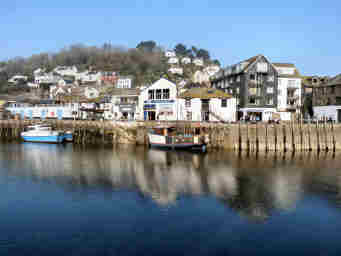
When I originally reported on Looe a few years ago, I was very harsh about it, really seeing only the tourist tat. In March 2009 I was in Looe when walking the Smugglers Way. I spent some time walking around the more interesting bits and taking a number of photos. Chris Halls, who runs the 'I Love Looe' website, had taken me to task about my scathing judgment on his town. Having been back in Looe and looked at it through different eyes, I am now happy to revise my original view - though not entirely. Looe comes in three parts. Divided by the River Looe are East Looe, the town's main resort and shopping area, and West Looe, residential and poor shops. The two are joined by a handsome many-arched bridge. Beyond West Looe is smart residential Hannafore with a beach. East Looe has an attractive waterfront with a major fish market, serving Cornwall's second largest fleet (the fish is said to be the best), handsome converted warehouses and the new lifeboat station. Behind these are the charming guildhall and old lifeboat station. Shops and restaurants look better than I remember (but many seem to close in winter) and I have had good fish and chips in Looe. There are lovely walks through Kilminorth Woods along the West Looe River. But, I'm sorry, I still don't like Looe's tatty touristy shops.