Lerryn
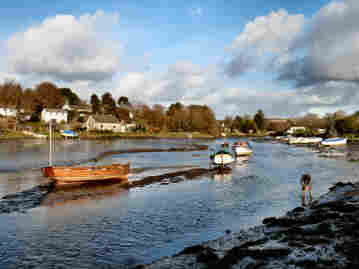
Although Lerryn in only 3 miles from Lostwithiel, and that seems the obvious way to approach it, I think that probably the best and most interesting way to approach the village is to start from Fowey and and take the Bodinnick Ferry across the Fowey River. This way not only will you have a good view of Daphne Du Maurier's parents' Ferryside home, but you will then travel along quiet lanes and through the charming hamlet of Lower Penpoll. Lerryn is clearly a wealthy little village. A number of handsome homes stand along both sides of the little River Lerryn, a tributary of the Fowey River. It is effectively a tidal creek, crossed by a medieval bridge and by stepping stones at low tide. Small boats line the river but don't move often - the very tidal nature of the river is quite restrictive. Signs of former industry include lime kilns built into homes and a former barn (maybe a warehouse) by the river. There is a lovely walk along the north side of the river to the tiny hamlet of St. Winnow. Try this walk in spring when the woodland is filled with bluebells and wild garlic. You can make a round walk of it by returning across fields to Winnow Mill, then through the National Trust's Ethy estate. We have enjoyed several good meals in the Ship Inn at Lerryn. There is a small amount of parking by the river, close to the Ship Inn.
Round Walk, Lerryn St. Winnow, Ethy
Boats on the river at Lerryn
3 mls SW of Lostwithiel; 4 ml from Fowey via Bodinnick ferry
More in Towns & Villages
Lewannick
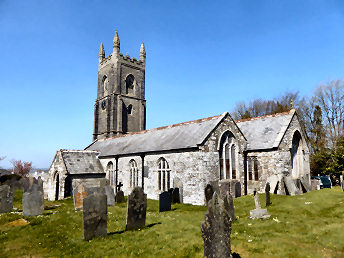
The village of Lewannick is about as far east as you can get in Cornwall, just off the fast A30 road and a couple of miles south-west of Launceston. I was there for the first time in April 2017, on a sunny Saturday. It is one of those relatively unusual Cornish villages where the church stands on a island of raised ground, six feet or so above the triangle of surrounding roads. I visited primarily to see two inscribed stones. One, inscribed in Latin and Ogham is in the church, the other is in the churchyard, south of the church. In the church porch, look up to see some unusual roof bosses. Inside are two fonts, one of unusual design with eight receptacles for water and a separate plinth, a carved wood pulpit, a carved stone reredos, and an unusual war memorial screen with painted panels. The chancel has a wagon roof with carved bosses. On the triangle of streets around the church are a pub, the Archer Arms, a former Police House of 1871, attractive Priory House (was there a priory here?) and, partly hidden down its driveway, the manor house.

Linkinhorne and Stoke Climsland
Climsland
Liskeard
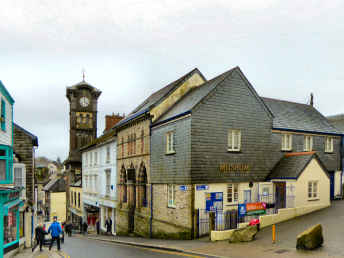
Liskeard is an odd town. First impressions were of dull, boring, mainly Victorian architecture, though I must confess that I visited on a dull rainy February 2016 day on which the dark stone of so many buildings left a dull, uninteresting impression. Previously I had only been in Liskeard (Cornish Lyskerrys, Kerywyd’s Court) on two occasions, once just passing through, on the other seeking a second-hand furniture shop (successful with an excellent buy of oak table and chairs). It is a town of some historical importance, a stannary (tin coinage) town from the 13th century, becoming a chartered borough in 1240. It became boom town in the second half of the 19th century, when most of its major buildings were built on tin and copper profits. The town is also odd in its layout. It stands on two hills, the western containing most of the major buildings, the eastern with Norman and later St. Martin’s church, the second largest in Cornwall after St. Petroc’s in Bodmin. On its north and south walls are thirteen consecration crosses, unique in Cornwall. Barras Street, The Parade and Pike Street have most of the other major buildings: Webb’s Hotel, Stuart House with its museums about the Civil War and about Henry Rice, major mid 19th century Liskeard architect, and excellent tile-hung small Town Museum next to Foresters Hall. In Well Street, off steep Pike Street, is the 16th century town well with its four outlets. Liskeard Revisited