Lanreath
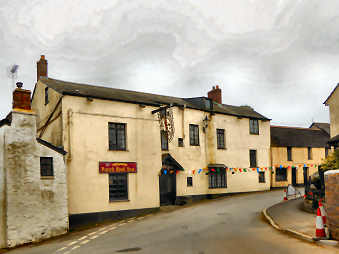
In early September I visited the village of Lanreath, abour five miles north-west of Looe. My primary purpose was to look at the church, of which more later, and to take a look at Court Barton, once the manor house of the Grylls family, now just a farmhouse. Happily there is a good sized car park by the village stores and post office - what a lucky village, still to have that alive and kicking. Sadly, the same could not be said for the Punchbowl Inn which closed in 2011 and looks very much like staying closed. But do look out for its entertaining inn sign, presumably made by a local blacksmith. Court Barton is a handsome, symetrically fronted early Jacobean house with some massive stone barns. St. Marnarch's church, its exterior essentially Perpendicular in style and well restored in 1887, consists of nave, south aisle, north transept and three stage tower. On your way in, do note the carved roof bosses in the porch. Inside are more roof bosses and two painted ceilings. A highly decorated font has an unusual octagonal cover. A board on one wall refers to Charles I as 'Prince' - in 1635! Another carries Charles II's coat of arms. The finely carved rood screen retains some medieval paintwork; in front of it is a carved Jacobean pulpit and lectern. A wall monument commemorates Charles Grylls and his wife. There is a colourful modern altar cloth. (July 2020, Punchbowl appears empty, fopr sale)
Lanreath's former Punchbowl Inn
Just off B3359 Middle Taphouse to Looe road. Signed.
More in Towns & Villages
Launceston
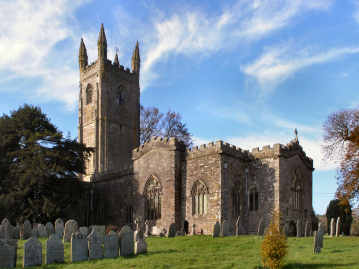
My earliest memories of Launceston are of an ordinary little town with a terrible traffic problem. That was in the 1950s when there were no decent roads into Cornwall. Now that the A30 bypasses the town, Launceston has regained the character it had before traffic congealed its arteries. We have visited twice recently - once for antiques (there are none that we could find) and then for quilting exhibitions. The quilts were wonderful - in St. Mary's church and at Cowslip Workshops at a nearby farm on the road from Egloskerry. Jo Colwill started Cowslip Workshops when foot-and-mouth had reduced farm income to zero. You can now learn sewing, quilting, embroidery, drawing and more and there is a shop, a restaurant and a gallery with good exhibitions. Launceston itself may lack good shops but it does not lack interest. The original settlement north of the river, now known as St. Stephens, has a fine church. In medieval Launceston you will find a ruined late Norman and 13th century castle, a 13th century town gate (the town walls are long gone), some handsome churches, notably that dedicated to St. Mary Magdalene, a good local museum in the National Trust's Lawrence House and a narrow gauge steam railway with its own museum. We were pleased to find Launceston much better than expected. Launceston re-visited 2016
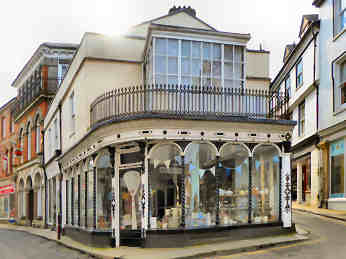
Launceston revisited in February 2016
revisited in February 2016
Lelant
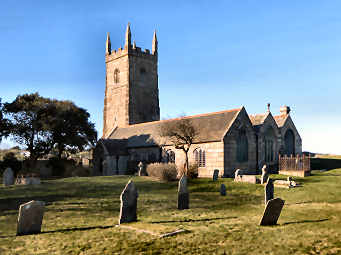
In January 2017 I had an expedition down west. First I went to see Towednack church, closed when I was there recently but happily open this time. Then I continued to Lelant where a little research in Langdon had suggested the existence of several Cornish Crosses. I checked on Cornwall Council's excellent Mapping Website and was able to confirm that I should find crosses in the churchyard of St.Uny Lelant, in the large cemetery and even on the main street. Previously I had only been in Lelant when on the Cornish Coast Path between Hayle and St. Ives. On that occasion I had taken the path between the church and its separate cemetery and not lingered at he church. On this occasion I stopped in the town first where, opposite the Badger Inn (formerly the Praed Arms) a Cornish Cross had been built into the wall next to Cross Cottage. There is now a War Memorial on the site but it looks as if the cross head is mounted on top of the memorial. In the cemetery I found 3 crosses; in the churchyard I found a further 2. The church is delightfully situated, next to a golf course and overlooking Hayle and the Hayle Estuary. Of interest in the church are 2 ancient slate memorials, an octagonal font, panelling from a medieval screen and a good reredos.