
More Trethevey
Trethevey
This Trethevy, just off the road between Tintagel and Boscastle, should not be confused with Trethevy Quoit at Darite south of Minions on Bodmin Moor. Yet, oddly, only a short distance from this Trethevy, and on the opposite side of the road, is a large flat stone known as KING ARTHURS' QUOIT. I visited this Trethevy early in October 2019, primarily totake a look at ST. PIRAN'S CHURCH, or Chapel as it should be known as it is a Chapel of Ease to St. Materiana's Church in Tintagel. I suggest, if there is space, parking in the Rocky Valley Car Park, on the other side of the main road from the lane up to St. Piran's Church. The lane is signed to Rocky Valley and it is only a hundred yards or so up the lane to church and well. There is more than just the church at Trethevy. Diagonally across the lane from the gate to the churchyard is ST. PIRAN'S HOLY WELL, the beehive shaped well house topped by a small iron cross. And, if you turn down the lane at the side of the church, signed as a footpath to Rocky Valley, you will find a ROMAN MILESTONE. This is believed to date from AD 251-3 and bears a rather illegible Latin inscription reading "For the Emperor Caesar, our Lords Gallus and Volusian." A few yards further along the lane is the entrance to St. Piran's House, believed once to have been part of a monastery. The first mention of the church was in 1457 when Parson Gregory received licence from the Bishop to celebrate Mass. A century later, after the Reformation, it was used as a farm building and it was not until 1914 that the owner, Sidney Harris, gifted it to the Church. After restoration, it eventually reverted to use as a Chapel and the first service was held in it on 9th February 1944. Further restoration took place as recently as 2015. Externally, the church is set partly into a small hill and is rectangular under a slate roof. Inside it is quite simple, the nave just a plain rectanguIar space. In the east wall is a small lancet window with a trefoil head. In the north wall an attractive modern stained glass window depicts St. Piran against a background of Rocky Valley. On one wall a plaque commemorates the Reverend Dudbridge Arundel, the vicar responsible for the restoration of the church. Another remembers Sidney Wickett Harris who gifted the building to the Church. The simple altar is made of darkish, slatey local stone. Furnishing is simple with plain wood pews, lacking in carved bench ends.
St. Piran's Holy Well
Trethevy, St. Piran's Church
The Roman Milestone
More Images of
Photographs
More in Towns & Villages
Morwenstow
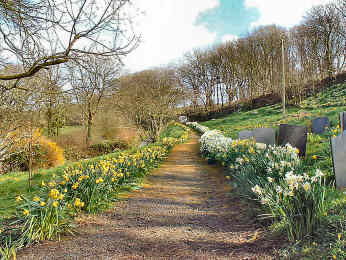
Comparatively inaccessible but definitely well worth going out of your way for, Morwenstow is Cornwall's most northerly parish; it is the 'holy place of St. Morwenna'. There are two tiny hamlets, Crosstown and Morwenstow. Crosstown is a collection of farms around a large village green, one incorporating a small pub, the Bush. Two tiny bars have half-a-dozen tables and a short, simple and inexpensive menu. A little further on towards the coast is Morwenstow Churchtown. Here are just a church, the former rectory, Rectory Farm, offering teas in summer, a couple of holy wells and Parson Hawker's famous Hut on the cliffs. In the churchyard are a Cornish cross, the figurehead from the 'Caledonia', wrecked off Higher Sharpnose Point, masses of daffodils in spring and, at the top, St. John's Well, accessed separately. A Norman doorway leads into a church with Norman arcading, a medieval fresco and some handsome carved bench ends. Most famous incumbent was Robert Stephen Hawker, vicar for 40 years from 1834.
Mousehole
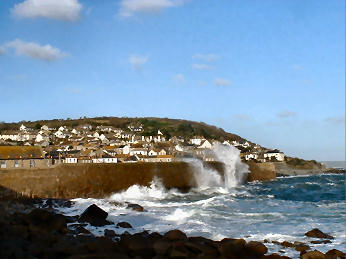
With a name like that (it is pronounced Mowzle) it would probably be famous anyway but is notable for its tiny enclosed harbour, granite cottages, little courtyards and flower-filled gardens - and a few tales. In 1595 the village was devastated, as were both Penzance and Newlyn, by a Spanish raid; the only building unscathed was a pub. In some unknown year, dreadful gales prevented the village’s fishing boats putting to sea. With the villagers almost starving, Tom Bawcock braved the storm to return with a massive haul of seven types of fish. His feat is celebrated every 23rd December when all Mousehole eats ‘Starry Gazy Pie’ (or stargazie), assorted fish heads looking heavenward through the crust. At this time, Christmas, Mousehole's lights are something to see.

Mullion
I looked around Mullion in February 2017 after re-vositing Gunwalloe Church Cove. I must admit that my look-around was not very thorough; esentially I just looked in the church then had a coffee in the friendly Old Inn opposite (there is a donation car park handy for both). Mullion has a population of around 2000, village proportions, but with Anglican, Methodist and Catholic churches, a secondary school, a fair range of shops including baker, grocer, newsagent, pharmacy, delicatessen, post office, off licence and clothes, plus pub, caf�s, rsstaurants and tea rooms, it has most of what you expect of a town. The largely 15th century church is noteworthy for its 40 early carved bench ends and for its screen which stretches across nave and two aisles. As you enter the porch, note the St. Christopher statue over the door and the dog gate in the door. But what is best known, and mosty visited, about Mullion is not the village but the harbour, a mile away at Mullion Cove. The National Trust owns the little harbour at Mullion Cove. For a National Trust location some of the buildings are a little tatty and you need to catch it on a sunny day, preferably without too many visitors, really to enjoy it. The future of the harbour is a little uncertain. It tends to suffer storm damage and the Trust's policy is one of "managed retreat".