Morwenstow
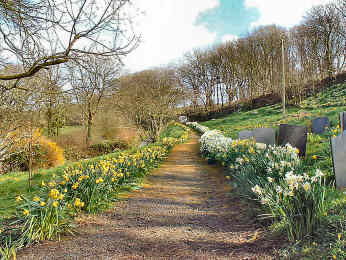
Comparatively inaccessible but definitely well worth going out of your way for, Morwenstow is Cornwall's most northerly parish; it is the 'holy place of St. Morwenna'. There are two tiny hamlets, Crosstown and Morwenstow. Crosstown is a collection of farms around a large village green, one incorporating a small pub, the Bush. Two tiny bars have half-a-dozen tables and a short, simple and inexpensive menu. A little further on towards the coast is Morwenstow Churchtown. Here are just a church, the former rectory, Rectory Farm, offering teas in summer, a couple of holy wells and Parson Hawker's famous Hut on the cliffs. In the churchyard are a Cornish cross, the figurehead from the 'Caledonia', wrecked off Higher Sharpnose Point, masses of daffodils in spring and, at the top, St. John's Well, accessed separately. A Norman doorway leads into a church with Norman arcading, a medieval fresco and some handsome carved bench ends. Most famous incumbent was Robert Stephen Hawker, vicar for 40 years from 1834.
Since writing the above, things have changed at the Bush Inn. It is really now a nice small hotel doing B&B and self-catering accommodation and boasting a new restaurant with a fairly classy looking menu.
A round walk includes Stanbury Mouth and Three Manors
The churchyard is a blaze of colour with daffodils
Signed by narrow lanes from A39 north of Bude
More in Towns & Villages
Mousehole
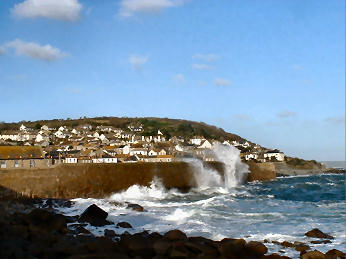
With a name like that (it is pronounced Mowzle) it would probably be famous anyway but is notable for its tiny enclosed harbour, granite cottages, little courtyards and flower-filled gardens - and a few tales. In 1595 the village was devastated, as were both Penzance and Newlyn, by a Spanish raid; the only building unscathed was a pub. In some unknown year, dreadful gales prevented the village’s fishing boats putting to sea. With the villagers almost starving, Tom Bawcock braved the storm to return with a massive haul of seven types of fish. His feat is celebrated every 23rd December when all Mousehole eats ‘Starry Gazy Pie’ (or stargazie), assorted fish heads looking heavenward through the crust. At this time, Christmas, Mousehole's lights are something to see.

Mullion
I looked around Mullion in February 2017 after re-vositing Gunwalloe Church Cove. I must admit that my look-around was not very thorough; esentially I just looked in the church then had a coffee in the friendly Old Inn opposite (there is a donation car park handy for both). Mullion has a population of around 2000, village proportions, but with Anglican, Methodist and Catholic churches, a secondary school, a fair range of shops including baker, grocer, newsagent, pharmacy, delicatessen, post office, off licence and clothes, plus pub, caf�s, rsstaurants and tea rooms, it has most of what you expect of a town. The largely 15th century church is noteworthy for its 40 early carved bench ends and for its screen which stretches across nave and two aisles. As you enter the porch, note the St. Christopher statue over the door and the dog gate in the door. But what is best known, and mosty visited, about Mullion is not the village but the harbour, a mile away at Mullion Cove. The National Trust owns the little harbour at Mullion Cove. For a National Trust location some of the buildings are a little tatty and you need to catch it on a sunny day, preferably without too many visitors, really to enjoy it. The future of the harbour is a little uncertain. It tends to suffer storm damage and the Trust's policy is one of "managed retreat".
Mylor Churchtown and Yacht Harbour
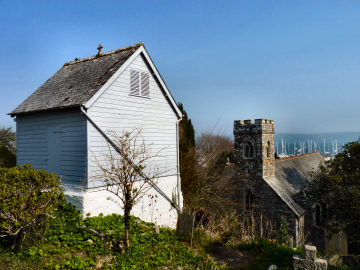
To many this is just Mylor Yacht Harbour, a major yachting and watersports centre where Mylor Creek joins Carrick Roads. With yacht club, large marina, extensive moorings, renowned boatyard and bars and restaurants, that’s understandable. As a result of the Harbour’s success property prices are among Cornwall’s highest and large houses spread along Mylor Creek. However, for others, this is Mylor Churchtown – to distinguish it from Mylor Bridge – and the main interest is the church of St. Mylor, quite unnoticed by much of the boating fraternity. One of Cornwall’s oldest holy sites, the first church is said to have been founded before AD411 when St. Mylor was martyred here. A charming church, set in a steeply sloping churchyard, there are two Norman doorways but the body of the church is essentially of 13th and 15th centuries. There are remains of a 15th century painted rood screen, an Elizabethan pulpit and a puzzling priest’s chair, reputed to have come from nearby Glasney College, closed when Henry VIII dissolved the monasteries, of 1000 year old Irish bog oak with Norse carving and Tudor panelling. The churchyard, lych gate at the top, small iron gate on the quay, is most enjoyable, Steeply sloping, it contains a free standing bell tower, St. Mylor’s holy well, a Cornish Cross that, if the whole shaft were visible, would stand 17’ 6” high, fine wild flowers, and ancient tombstones, one commemorating the 200 who died when Queen was wrecked on Trefusis Point.