Mylor Churchtown and Yacht Harbour
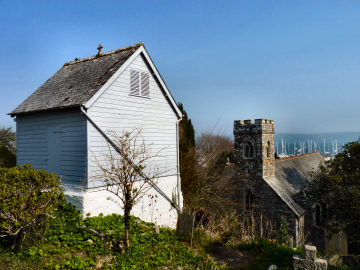
To many this is just Mylor Yacht Harbour, a major yachting and watersports centre where Mylor Creek joins Carrick Roads. With yacht club, large marina, extensive moorings, renowned boatyard and bars and restaurants, that’s understandable. As a result of the Harbour’s success property prices are among Cornwall’s highest and large houses spread along Mylor Creek. However, for others, this is Mylor Churchtown – to distinguish it from Mylor Bridge – and the main interest is the church of St. Mylor, quite unnoticed by much of the boating fraternity. One of Cornwall’s oldest holy sites, the first church is said to have been founded before AD411 when St. Mylor was martyred here. A charming church, set in a steeply sloping churchyard, there are two Norman doorways but the body of the church is essentially of 13th and 15th centuries. There are remains of a 15th century painted rood screen, an Elizabethan pulpit and a puzzling priest’s chair, reputed to have come from nearby Glasney College, closed when Henry VIII dissolved the monasteries, of 1000 year old Irish bog oak with Norse carving and Tudor panelling. The churchyard, lych gate at the top, small iron gate on the quay, is most enjoyable, Steeply sloping, it contains a free standing bell tower, St. Mylor’s holy well, a Cornish Cross that, if the whole shaft were visible, would stand 17’ 6” high, fine wild flowers, and ancient tombstones, one commemorating the 200 who died when Queen was wrecked on Trefusis Point.
Mylor Church - Walk from Churchtown
Mylor church and its detatched wooden bell tower
From A39, just SW of Perranarworthal, 2nd L, follow signs
More in Towns & Villages
Newlyn
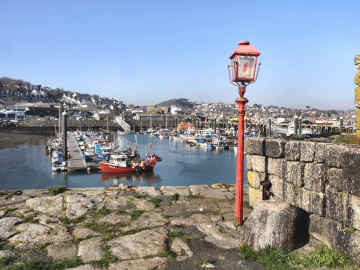
Adjacent Penzance is the biggest resort on the south coast of Cornwall, but Newlyn is said to have the third largest fishing fleet in Britain. First impressions are of a gritty working town but there are some quite attractive cottages in streets running up the hill. Focus, of course, is the harbour from which about a hundred boats operate. The fish auction starts at 8 a.m. each day and sells around 10,000 tons of fish a year. Pilchards were once the mainstay but the old Pilchard Works is now apartments. There is a modern art gallery at the east end of town. Oddly, if you want to see Newlyn School artists, you will have to go to Penlee House gallery in Penzance. Just south along the coast is Mousehole.
Newquay
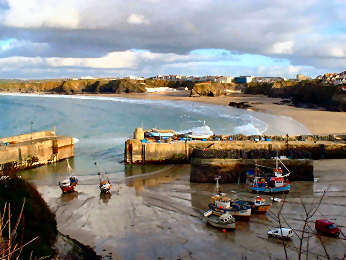
An odd mixture of tawdry down-market resort and delightful cliffs, headlands and beaches, this is a place best seen on foot along the waterfront. Two hundred years ago just a mining and fishing village, the railroad then brought wealthy visitors and grand hotels. Lapsing to down-market in the 20th century, Newquay's discovery as a surfers paradise (Fistral is the major surfing beach) has seen much improvement. A Huer's Hut was once the look-out tower for pilchard shoals. The eight-man pilot gig is now raced; once the gigs competed to get their pilot to incoming boats first. One aspect of Newquay of which I have no experience is its nightlife. I am happy for it to stay that way. I am told that the many clubs and nightclubs seethe with action at night, much of it drunken and troublesome.
Old Kea
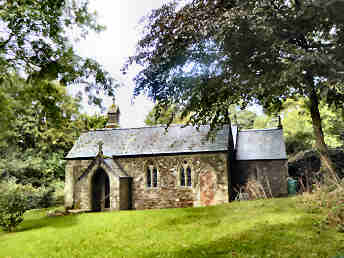
Late in September 2016 I made an expedition to the other side of Truro to look at Loe Beach, Feock village and church, Old Kea and Kea, tha latter two no more than hamlets. Loe Beach may sound promising but is a great disappointment. In season, a car park, caf� and slipway; out of season, a boat park, no car park or caf�, and a poor quality beach. It is saved only by views down Carrick Roads. Old Kea, however, is well worth a visit. It consists only of Churchtown Farm, the ivy-clad tower of the former medieval church, and a charming small Victorian church in the photo to the left. Outside the porch is the shaft of an old Cornish Cross. The free-standing tower is all that remains of a monastery, founded in the 13th century on the site of St. Kea's original monastery, and then important enough that its 7000 acre estate extended to Baldhu, Chacewater and Scorrier. Inside is a simply carved early font and a newly (October 2016) dedicated stained glass window in the tiny chancel. This is a charming spot, well off the beaten track. I first encountered it in the course of a Fal Creeks walk from the National Trust''s Trelissick estate. Kea: Kea church was a disappointment. I was unable to gain access to the Victorian building (a notice in the porch said "Welcome", so why was the door firmly locked). The exterior has little to commend it, except for an attractive lead-covered spire, unusual for Cornwall.