St. Mawgan
Mawgan
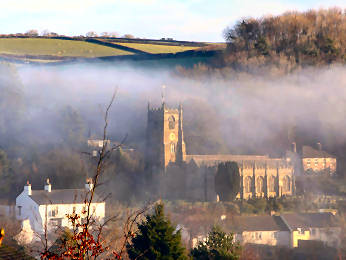
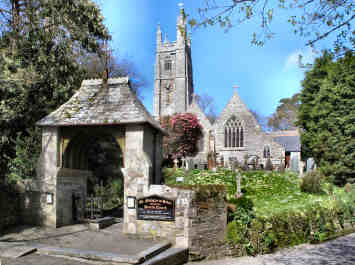
On a sunny day in February 2006 Jane and I parked down at Mawgan Porth and walked the couple of miles up the valley to St. Mawgan village - officially Mawgan in Pydar - primarily to visit the Japanese Garden there and have lunch in the Falcon Inn. We enjoyed much more than just the garden. The walk up from the coast is an easy and pleasant one, first along the open valley, than gently up through light woodland. The village is charming, the garden pleasant and the Falcon Inn and the nearby tearooms good. Cottages in the village are immaculate and expensive looking. The church, mostly of the 13th to 15th centuries, has an impressively pinnacled tower, a 20th century lych gate and a much admired lantern cross near the porch. Inside are 15th century bench ends, some brasses and, surprisingly, a rood screen and loft. Behind the church, the big house is Lanherne, once seat of the Arundell family of Trerice. The male line died out in 1701 and in 1794 the house was given to Carmelite nuns; apparently it is still a convent but of a different order. Opposite Lanherne's entrance a farm has a charming range of small buildings, best seen from up the hill. We had a light lunch in the attractive Falcon Inn, excellent soup and rich garlic bread, with a large fire blazing nearby and a wedding party lunching in the dining room.
A round walk from St. Mawgan includes Mawgan Porth and Lanherne Vale
St. Mawgan's handsome church
St. Mawgan revisited. St. Mawgan's Japanese Garden
St.
Mawgan Revisited
After visiting St. Newlyn East at the end of June 2016, I spent an hour or so in St. Mawgan. I had not previously been round the church and, as June seems to have been my month for churches, thought I should concentrate on the church. My timing was good as, soon after I left, a weddding was to begin. These days, thanks partly to the enthusiasm of one of Jane's friends, Sue Holman, I have started looking out for Cornish Crosses. In the churchyard here, I found three quite different - a conventional cross, a wheel cross and a lantern cross - and what looked to me like a separate cross base. Inside the church, the screen is bare of infilling but still has some fine carved detail. There is a good collection of carved bench ends, many of them 15th century, and the 16th century pulpit has carved panels showing the Suffering of Jesus. The Lady Chapel, where a panel of the stained glass window depicts St. Mawgan, has an unexpected and very fine collection of brasses, including a wall panel of copies. The screen has a central arch with two gilded angels supporting a shield representing the Arundell and Carminow families. On the Chancel side is a fragment of a much older carving of men and animals. The font is unuual, late Norman with zig-zag moulding round the rim, four heads as capitals and coloured stone support columns. A slate coat of arms remembers members of the Vyell family, also commemorated at St. Breock
St. Mawgan church from the south-east
And Even More St.