St. Teath
Teath
I had driven through St. Teath on a number of occasions, most particularly when heading for the general area of Trebarwith and Trewarmet, on one occasion when preparing an item on Prince of Wales Engine House, on others when doing round walks from Jeffreys Pit, one taking in Delabole Quarry, another including well known Trebarwith Strand. On this occasion my expedition was first to revisit St. Tudy to have a detailed look around its church, then to explore St. Teath. This is a slightly difficult village; a narrow road winds through it with little in the way of pavement and there is little in the way of parking unless you can justify using the vast car park of the White Hart Inn. The obvious focus of the village is the church but there are also some attractive cottages up lanes to the south of the church. Opposite the pub a small square is dominated by a clock tower; behind it is the church on a raised circular site, probably of prehistoric significance. The church is dedicated to St. Tetha, thought to be one of the twenty four daughters of Welsh King Brychan. The church consists of nave, two aisles and a three stage tower. Inside are handsome roofs with carved bosses, a carved pulpit bearing a coat of arms, carved choir stall fronts, some good bench ends and a font that appears to be of blue elvan stone. A church hall, on the edge of the churchyard, now operates as a snooker hall.
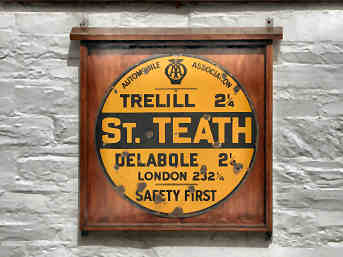
Old AA sign on the wall of the White Hart
At Knightsmill on A39 N of Wadebridge, follow St. Teath sign W
St.
More in Towns & Villages
St. Tudy
Tudy
St. Winnow
Best approached, as on the walk below, by following the Rivers Lerryn and Fowey, through broadleaf Ethy Wood and more coniferous Middle Wood. And best of all, approached in late spring when the bluebells and wild garlic proliferate, shown off at their best by the delicate new greenery of Ethy wood. St. Winnow is a tiny hamlet: just a church, a small boatyard, a couple of farms (one selling organic meats and cream teas) and a former boathouse converted to a holiday home. The setting on the River Fowey is idyllic. The church stands where St. Winnoc (some think him the same as Winwaloe) is said to have founded an oratory in around 670AD. Inside are the usual Cornish wagon roofs and some charming and unusual medieval bench ends, including a ship in full sail and a Cornishman in a kilt! There is some stained glass and the 16th century rood screen has been restored. Outside, elaborate Cornish crosses remember several Barons Vivian, local landowners. We have enjoyed cream tea from a seasonal snack shack by the farm before the return leg through the National Trust's Ethy estate. On the way you pass interesting St. Winnow Mill, which worked right up until 1940. The miller's house, listed Grade II is nearby but not very visible. Another mill, Notts Mill, halfway down the valley, on an alternative route, is now a private house.
Stratton
As Stratton is close to the English border, you might expect the name to mean "the settlement on the (Roman) road". However, it derives from the little River Stret and means "the valley of the river Neet or Stret". Knowing Stratton previously only as somewhere to pass through on the way to North Devon or to Holsworthy, I was pleasantly surprised when I parked in the free car park on the Holsworthy road and walked up the hill to the church. First, I took photos of attractive Thistledown and Tudor Cottages and of Bridge Cottages across the road. Then I climbed steep Old Post Office Hill through simple Rattenbury Gardens and past the ancient Tree Inn, continuing on up Fore Street to Church Street, a War Memorial, more attractive cottages (see right) and St. Andrews Church. As you approach the church from the lych gate you see a striking (unused) tower entrance, a small statue of St. Andrew above it. Inside is a "clink" door from a former prison. The roofs have carved bosses. There is an elaborate screen, a carved pulpit and an unusual modern brass font cover. Unlike nearby Kilkhampton and Poughill, there are almost no carved bench ends, The Civil War Battle of Stamford Hill took place on 16 May 1643, just off the lane to Poughill; here Hopton's Royalist army defeated Chudleigh's Parliamentarian troops.