St. Tudy
Tudy
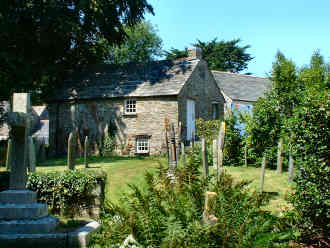
We drove through St. Tudy many years ago, found it charming, and promised ourselves we would return to take a closer look. It took a long time but eventually we were back there for a Village Gardens day in July 2006. We should have been there a long time ago, it must be the most attractive inland village in Cornwall and, to judge by its former web site, one with a great sense of community, despite the large number of incomers. In fact, much as some Cornish may dislike the idea - because of the unfortunate effect on property prices in a low wage area - it is the incomers who have made St. Tudy so attractive. The shape of the village is unusual, dictated by the seven or eight lanes that converge at its centre. The church is inevitably at the heart of the village, attractive from the outside but sadly over-restored inside. At its east end is the 17th century 'clink', first an ale-house, then the village lock-up, later a school. Close to the church is a small school, a post office and village stores, and the St. Tudy Inn (we have yet to try it but it is unattractive from the outside). What more could a village want in these days of ghost villages. Around the fringes of the large parish are several manor houses, the most famous of these being Tinten, birthplace of Admiral Bligh 'of the Bounty'. St. Tudy Church
Round Walk from St. Tudy includes fields, woodland and Weatherham.
Signed from A39 between Wadebridge and Camelford
St. Tudy's 17th century village 'clink'
More in Towns & Villages
St. Winnow
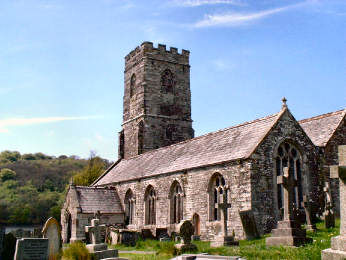
Best approached, as on the walk below, by following the Rivers Lerryn and Fowey, through broadleaf Ethy Wood and more coniferous Middle Wood. And best of all, approached in late spring when the bluebells and wild garlic proliferate, shown off at their best by the delicate new greenery of Ethy wood. St. Winnow is a tiny hamlet: just a church, a small boatyard, a couple of farms (one selling organic meats and cream teas) and a former boathouse converted to a holiday home. The setting on the River Fowey is idyllic. The church stands where St. Winnoc (some think him the same as Winwaloe) is said to have founded an oratory in around 670AD. Inside are the usual Cornish wagon roofs and some charming and unusual medieval bench ends, including a ship in full sail and a Cornishman in a kilt! There is some stained glass and the 16th century rood screen has been restored. Outside, elaborate Cornish crosses remember several Barons Vivian, local landowners. We have enjoyed cream tea from a seasonal snack shack by the farm before the return leg through the National Trust's Ethy estate. On the way you pass interesting St. Winnow Mill, which worked right up until 1940. The miller's house, listed Grade II is nearby but not very visible. Another mill, Notts Mill, halfway down the valley, on an alternative route, is now a private house.
Stratton
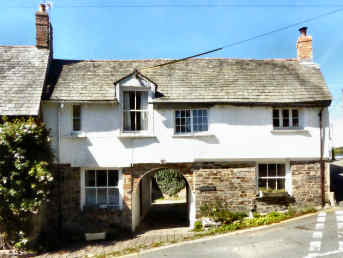
As Stratton is close to the English border, you might expect the name to mean "the settlement on the (Roman) road". However, it derives from the little River Stret and means "the valley of the river Neet or Stret". Knowing Stratton previously only as somewhere to pass through on the way to North Devon or to Holsworthy, I was pleasantly surprised when I parked in the free car park on the Holsworthy road and walked up the hill to the church. First, I took photos of attractive Thistledown and Tudor Cottages and of Bridge Cottages across the road. Then I climbed steep Old Post Office Hill through simple Rattenbury Gardens and past the ancient Tree Inn, continuing on up Fore Street to Church Street, a War Memorial, more attractive cottages (see right) and St. Andrews Church. As you approach the church from the lych gate you see a striking (unused) tower entrance, a small statue of St. Andrew above it. Inside is a "clink" door from a former prison. The roofs have carved bosses. There is an elaborate screen, a carved pulpit and an unusual modern brass font cover. Unlike nearby Kilkhampton and Poughill, there are almost no carved bench ends, The Civil War Battle of Stamford Hill took place on 16 May 1643, just off the lane to Poughill; here Hopton's Royalist army defeated Chudleigh's Parliamentarian troops.
Talland and Porthallow
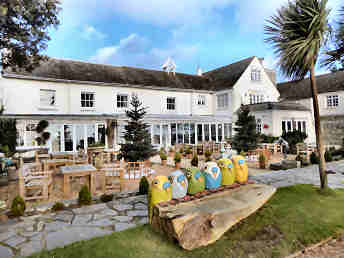
The nearest I had previously been to Talland and Porthallow was when walking the Cornish Coast Path between Polperro and Looe in April 2010. The path passes through the two coves of Talland Bay; the tiny villages of Talland and Porthallow [not to be confused with Porthallow on the Lizard] are up a steep hill inland from Talland Bay. There are some attractive cottages in the villages and the child and dog friendly Talland Bay Hotel in Porthallow village is strongly recommended for its location and lunchtime light food. The church of St. Tallanus is in Talland village. It's a most unusual church, set into a steeply sloping graveyard. As you enter the porch, the body of the 13th to 15th century church, uniquely dedicated to St. Tallanus, is to your right, the detached tower is up steps to your left. Inside are some good memorials and a very fine collection of carved bench ends, mostly of the 16th century. Down in the bay, one cove has a car park and beach caf�, the other a large car park, at its top, behind Smugglers Cottage, the Smugglers Rest caf�. We visited in 2015, between Christmas and New Year. Car parks and toilets in the coves were closed for the winter. There is a path between hotel and beach but we opted to drive the steep hill between the two. The hotel was dressed inside and outside to entertain children in the festive season. It entertained us, too.