Castle Killibury - a putative Arthurian site
Killibury - a putative Arthurian site
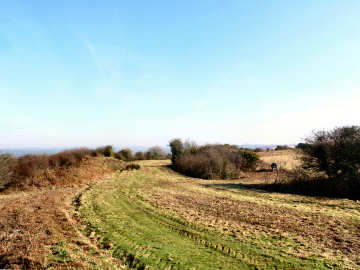
Although Castle Killibury is only a couple of miles from our home in Wadebridge, I only got round to taking a look in January 2007, using it as the destination of a walk up the Allen Valley. The interest in Castle Killibury (also known as Kelly Rounds) stems from its putative Arthurian connection. The Welsh Mabinogion refers to Arthur as "chief prince in Celliwig in Cerniw". Cerniw (or Kernow) is Cornwall and Killibury (an anglicisation) is one of several camdidates for Celliwig. The site was occupied during both bronze age and iron age and there is some evidence of occupation (but not re-fortification) in Arthur's time. Sadly, half the site is now farm buildings and banks and ditches are overgrown by thorn bushes. In form it is bivallate, 200 yards in diameter and had a square annexe on its west side, now ploughed out. So, unless you are a convinced Arthurian, it is scarcely worth seeing. Which brings me to one of my pet gripes about a certain type of Cornish nationalist. Elsewhere I have suggested that, instead of defacing English Heriitage signs, they should join Cornwall Heritage Trust to help them care for our historic sites. It would be great if their nationalism should encourage them to do something about caring for sites like Castle Killibury and Helsbury Castle, sadly neglected compared with similar English sites.
Outer bank to left, inner bank, ditch, entrance to right
OS Explorer sheet 106 at 018/736, due E of Three Hole Cross
I revisited Killibury in February 2008. To my delight, some of the site had been cleared and banks (but not ditches) were much more visible. The low-profiled site is very difficult to photograph but I hope the image above is better than last year's. While there I chatted to Gordon, member of Tamar Dowsers, doing a recce prior to a group visit.
More in Antiquities
Castle-an-Dinas near St. Columb Major
Dinas near St. Columb Major
Chapel Carn Brea Bronze Age Tomb
Brea Bronze Age Tomb

Chysauster Iron Age Village
Where Carn Euny has only been partially excavated, Chysauster (its name is actually 'Chy Sylvestra', meaning the houses in the wood) has been more fully excavated since its discovery in around 1860, much the same time as Carn Euny. Unlike earlier Carn Euny, Chysauster dates from around the birth of Christ and was occupied during the Roman period. Being later, it is more sophisticated, consisting of nine courtyard houses, mostly fairly fully excavated. As you can see from the photograph, its substantial walls rise to around eight feet. The houses are known as 'courtyard houses' because the four or five rooms, backed by massive stone walls, surround an open courtyard. They are entered by a long entrance passage, believed to have been gated, giving a good degree of privacy. In the centre of the main room, a stone in the floor has a hole where a timber would have supported a thatched roof. In evidence are hearths, corn-grinding stones and covered sewers. Each of the houses appears to have had its own terraced garden. The fogou, unlike that at Carn Euny, is in a ruinous state and is not open. The site is in the care of English Heritage so there is a small entrance fee. The walk from the car park to the site is a gentle climb of about quarter of a mile. There is a small shop in the reception hut but no refreshments.