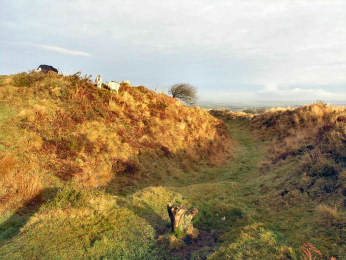
Castle-an-Dinas near St. Columb Major
Dinas near St. Columb Major
The largest and most easily accessible iron age hill fort in Cornwall, not to be confused with one of the same name in West Penwith, Castle-an-Dinas stands on a 700 foot hilltop south-east of St. Columb Major. There are two rings of bank and ditch, the outer perimeter a full half mile, the area around 10 acres. 4000 years ago all that stood here were two bronze age barrows, still just discernable. Over 2000 years ago, when the fort was constructed, it would have been a hive of activity. In 1646, in the Civil Wars, it saw Hopton's royalist forces camping overnight. Until 1958 it was the site of a major wulfram (tungsten) mine and an aerial ropeway ran from the ramparts to works buildings that still stand by the car park. Now it is just populated by sheep and goats, who probably pay no attention at all to the great panoramas - a toposcope stands by a barrow. A lot of stories surround this isolated spot. Reputedly it was the site of King Arthur's hunting lodge and the place where Cador, King of Cornwall and husband of Arthur's mother Igerne, died. It is said that ghostly armies have been seen in the skies above the fort. Both murders and executions have taken place here. Standing on the ramparts, and enjoying the long views, it is hard to imagine these events. Interestingly, Daphne Du Maurier uses it as the site of Castle Dore in her novel Castle Dor.
Castle an Dinas; sheep and goats graze
Off un-numbered road, 2 miles E of junction of A39 and A3059
Castle
More in Antiquities
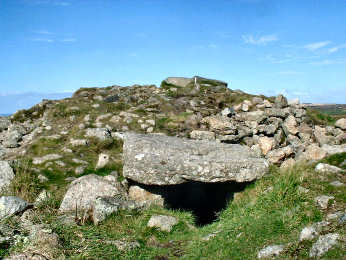
Chapel Carn Brea Bronze Age Tomb
Brea Bronze Age Tomb

Chysauster Iron Age Village
Where Carn Euny has only been partially excavated, Chysauster (its name is actually 'Chy Sylvestra', meaning the houses in the wood) has been more fully excavated since its discovery in around 1860, much the same time as Carn Euny. Unlike earlier Carn Euny, Chysauster dates from around the birth of Christ and was occupied during the Roman period. Being later, it is more sophisticated, consisting of nine courtyard houses, mostly fairly fully excavated. As you can see from the photograph, its substantial walls rise to around eight feet. The houses are known as 'courtyard houses' because the four or five rooms, backed by massive stone walls, surround an open courtyard. They are entered by a long entrance passage, believed to have been gated, giving a good degree of privacy. In the centre of the main room, a stone in the floor has a hole where a timber would have supported a thatched roof. In evidence are hearths, corn-grinding stones and covered sewers. Each of the houses appears to have had its own terraced garden. The fogou, unlike that at Carn Euny, is in a ruinous state and is not open. The site is in the care of English Heritage so there is a small entrance fee. The walk from the car park to the site is a gentle climb of about quarter of a mile. There is a small shop in the reception hut but no refreshments.

Ch�n Castle and Ch�n Quoit
Ch�n Castle and the nearby Ch�n Quoit neolithic burial chamber are among Cornwall's least accessible ancient monuments. Footpaths to the site are not signed and you will need to find Trehyllys Farm (please ask the farmer's permission to park) near Great Bosullow, a mile off the Penzance to Morvah road. It is worth it; the ragged ruins of Ch�n Castle suggest the former size of this iron age fort. Almost 200 feet in diameter, its tumbled walls must have been six feet thick - and in 1951 Jacquetta Hawkes recorded that, in living memory, its walls had stood twelve feet high. She believed it to have been connected with the tin trade. While you will need to use considerable imagination, this is an impressively dominant site, which must have been much like an Irish rath and similar to Staigue Fort in Ireland's County Kerry. Use OS Explorer Sheet 102, whether coming by car or in the course of a hike. You could include a visit to nearby Men-an-Tol stones.