
Ch�n Castle and Ch�n Quoit
Ch�n Castle and the nearby Ch�n Quoit neolithic burial chamber are among Cornwall's least accessible ancient monuments. Footpaths to the site are not signed and you will need to find Trehyllys Farm (please ask the farmer's permission to park) near Great Bosullow, a mile off the Penzance to Morvah road. It is worth it; the ragged ruins of Ch�n Castle suggest the former size of this iron age fort. Almost 200 feet in diameter, its tumbled walls must have been six feet thick - and in 1951 Jacquetta Hawkes recorded that, in living memory, its walls had stood twelve feet high. She believed it to have been connected with the tin trade. While you will need to use considerable imagination, this is an impressively dominant site, which must have been much like an Irish rath and similar to Staigue Fort in Ireland's County Kerry. Use OS Explorer Sheet 102, whether coming by car or in the course of a hike. You could include a visit to nearby Men-an-Tol stones.
Ch�n Castle, massive tumbled walls by the entrance
Ch�n Quoit
Some time after writing the above report I discovered another longer, but probably better route to Ch�n. Park to the east of the site at Woon Gumpus Common on the road south from Pendeen. Paths are cleartly waymarked and lead gently to Ch�n, which is on the Land's End Trail.
Photographs
More in Antiquities
CORNISH ANCIENT SITES PROTECTION NETWORK
ANCIENT SITES PROTECTION NETWORK
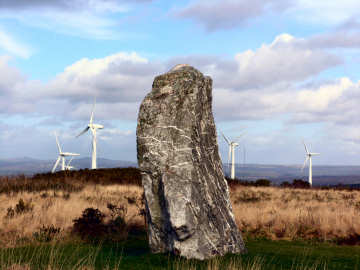
CORNWALL HERITAGE TRUST
HERITAGE TRUST
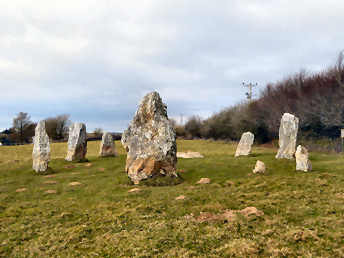
Duloe Stone Circle and St. Cuby's Well
Unusually, this entry appears on three different pages: here under antiquities but also on my towns and villages page and my churches and holy places page. The reason is that, for such a small village, there is so much variety of interest. The form of the church, while not unique to Cornwall, is most unusual. It consists of nave, north aisle, south transept and a strange leaning tower attached to the south transept. The tower was once taller but the top stage was replaced by a pyramidal roof in the 19th century. It leans northwards at a sharper angle than the Leaning Tower of Pisa; fortunately the rest of the church holds it up. Inside, behind an elaborate parclose screen, possibly made from the former rood screen, the chancel aisle was built as the Colshull family chapel and contains Sir John Colshull's tomb, his recumbent effigy on it, and several elaborate slate memorials. The rood loft may be gone but the stair and loft doors remain. About 600 yards south of the church, alongside the road to Looe, is St. Cuby's Holy Well. What is claimed to be his original font was moved from the well site and now stands in the church. A few yards north of the church a sign directs you to Duloe Stone Circle, a small circle of 8 stones, believed by some once to have enclosed a cairn. A storyboard, somewhat weathered, stands by the hedge behind the circle.