CORNISH ANCIENT SITES PROTECTION NETWORK
ANCIENT SITES PROTECTION NETWORK
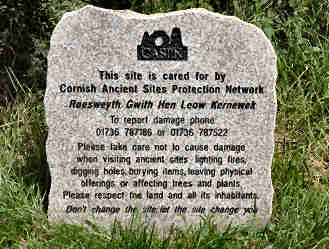
Until I did an antiquities walk from Lamorna in July 2007 I had never heard of the CASPN - in Cornish Roesweyth Gwith Hen Leow Kernewek. Then at the Merry Maidens Stone Circle I found a handsome polished granite tablet recording their interest in the site. It seems the Network was founded as a charity in 2000 to bring together the many bodies responsible (in some cases, irresponsible) for the care of Cornwall's vast number of ancient sites. CASPN was formed after a number of vandal attacks on prominent ancient sites. A large number of fairly disparate bodies are involved, amongst them National Trust, Cornwall Council’s Historic Environment Service, Cornwall Archaeological Society, English Heritage, English Nature, Cornwall Wildlife Trust, Cornwall Heritage Trust, Penwith District Council, Penwith Access and Rights of Way, Penlee Gallery and Museum, Madron Community Forum, Zennor Parish Council, Cornish Earth Mysteries Group, Pagan Federation, Pagan Moot, Meyn Mamvro and the Order of Bards, Ovates and Druids. The main focus seems to be the West Penwith area, as you might expect with its abundance of ancient sites. I haven't yet seen their tablets elsewhere but I hope to; I have to applaud their efforts.
The Merry Maidens CASPN tablet
Information gleaned from CASPN's website
Online Mapping - Cornwall Council's
More in Antiquities
CORNWALL HERITAGE TRUST
HERITAGE TRUST
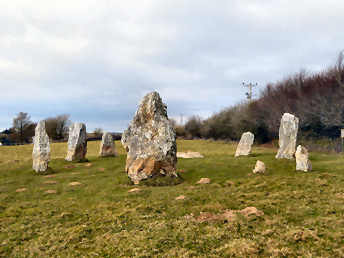
Duloe Stone Circle and St. Cuby's Well
Unusually, this entry appears on three different pages: here under antiquities but also on my towns and villages page and my churches and holy places page. The reason is that, for such a small village, there is so much variety of interest. The form of the church, while not unique to Cornwall, is most unusual. It consists of nave, north aisle, south transept and a strange leaning tower attached to the south transept. The tower was once taller but the top stage was replaced by a pyramidal roof in the 19th century. It leans northwards at a sharper angle than the Leaning Tower of Pisa; fortunately the rest of the church holds it up. Inside, behind an elaborate parclose screen, possibly made from the former rood screen, the chancel aisle was built as the Colshull family chapel and contains Sir John Colshull's tomb, his recumbent effigy on it, and several elaborate slate memorials. The rood loft may be gone but the stair and loft doors remain. About 600 yards south of the church, alongside the road to Looe, is St. Cuby's Holy Well. What is claimed to be his original font was moved from the well site and now stands in the church. A few yards north of the church a sign directs you to Duloe Stone Circle, a small circle of 8 stones, believed by some once to have enclosed a cairn. A storyboard, somewhat weathered, stands by the hedge behind the circle.
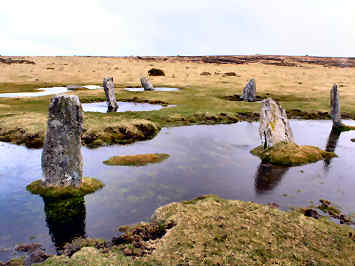
East Moor, Fox Tor and Nine Stones Circle
In early April 2006, having finished walking Mark Camp's Copper Trail, I went back to Five Lanes to investigate an area that I had looked at briefly on the trail and that had attracted me when studying the Ordnance Survey map. This lies just off the Copper Trail, to the south of Five Lanes and the A30 highway. In a fairly complex walk I took a lane through Tregirls and up onto the moor at Eastmoorgate, having checked first that East Moor is an unrestricted Open Access area. Once on the moor I headed up 1100 foot Fox Tor - great views in all directions - where there are traces of a boundary bank and the outlines of former long houses. Then westwards to find what had been a massive boundary bank and on to the south-east up another hill for a stone row and a couple of degraded cairns. South then for the Greymare Rock (not really an antiquity) and hut circles on Carey Tor. Finally northeast to find the Nine Stones circle. My one failure was that I could not find a line of Altarnun parish boundary stones, though I had previously found one near Clitters on a Copper Trail walk. A great walk and fascinating, if mostly rather rudimentary, remains. Afterwards I enjoyed another great, and good value, beef and onion baguette at the King's Head at Five Lanes.