
Chysauster Iron Age Village
Where Carn Euny has only been partially excavated, Chysauster (its name is actually 'Chy Sylvestra', meaning the houses in the wood) has been more fully excavated since its discovery in around 1860, much the same time as Carn Euny. Unlike earlier Carn Euny, Chysauster dates from around the birth of Christ and was occupied during the Roman period. Being later, it is more sophisticated, consisting of nine courtyard houses, mostly fairly fully excavated. As you can see from the photograph, its substantial walls rise to around eight feet. The houses are known as 'courtyard houses' because the four or five rooms, backed by massive stone walls, surround an open courtyard. They are entered by a long entrance passage, believed to have been gated, giving a good degree of privacy. In the centre of the main room, a stone in the floor has a hole where a timber would have supported a thatched roof. In evidence are hearths, corn-grinding stones and covered sewers. Each of the houses appears to have had its own terraced garden. The fogou, unlike that at Carn Euny, is in a ruinous state and is not open. The site is in the care of English Heritage so there is a small entrance fee. The walk from the car park to the site is a gentle climb of about quarter of a mile. There is a small shop in the reception hut but no refreshments.
Chysauster, part of village in its landscape setting
B3311 Penzance-St. Ives, turn NW at Badgers Cross 1� miles
More in Antiquities

Ch�n Castle and Ch�n Quoit
Ch�n Castle and the nearby Ch�n Quoit neolithic burial chamber are among Cornwall's least accessible ancient monuments. Footpaths to the site are not signed and you will need to find Trehyllys Farm (please ask the farmer's permission to park) near Great Bosullow, a mile off the Penzance to Morvah road. It is worth it; the ragged ruins of Ch�n Castle suggest the former size of this iron age fort. Almost 200 feet in diameter, its tumbled walls must have been six feet thick - and in 1951 Jacquetta Hawkes recorded that, in living memory, its walls had stood twelve feet high. She believed it to have been connected with the tin trade. While you will need to use considerable imagination, this is an impressively dominant site, which must have been much like an Irish rath and similar to Staigue Fort in Ireland's County Kerry. Use OS Explorer Sheet 102, whether coming by car or in the course of a hike. You could include a visit to nearby Men-an-Tol stones.
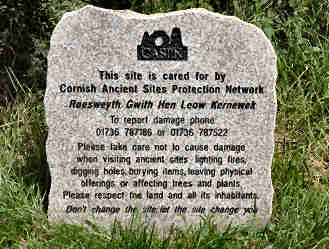
CORNISH ANCIENT SITES PROTECTION NETWORK
ANCIENT SITES PROTECTION NETWORK
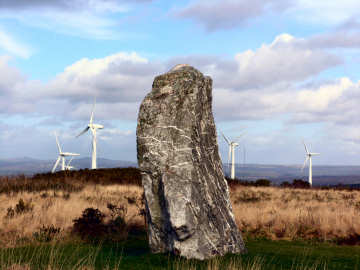
CORNWALL HERITAGE TRUST
HERITAGE TRUST