
Fox Tor, Nine Stones and Clitters Hill
Clitters Hill
On a bitterly cold, but gloriously sunny, day in January 2009 I decided to revisit Fox Tor and East Moor. This time to try to find the long line of boundary stones - marking the boundary of the parishes of Altarnun and North Hill. Again, I parked at Five Lanes and approached Fox Tor from Eastmoorgate. When I had looked for the boundary stones before I had started in the south-west, south of the Greymare rock. This time I headed from the East Moor ring cairn east towards Ridge and easily found the stones on a low ridge running north-east directly towards the Nine Stones of Altarnun circle. At the circle the row veers a bit east and heads downhill to the corner of Clitters Plantation and the path from Newton to Clitters. As on Fox Tor, East Moor, Carey Tor and Ridge, there is a lot of archaeology on Clitters Hill. Not just that shown on OS109 - settlement, field system and hut circles - but at least one more probable cairn. At the path below the hill I then took a field path north down to a ford and a wooden footbridge across the little River Lynher. I then found Upton Castle. On private land, it is very badly overgrown but seems to be a small 'keep and ringwork' castle. I made my way back to the car by Upton Barton farm and paths to Trenilk.
Full directions for a similar walk at Bodmin Moor Walks, Walk A30 05
A distinctive thorn grows on top of Clitters Cairn
On OS Explorer 109. Mostly Open Access land
More in Antiquities
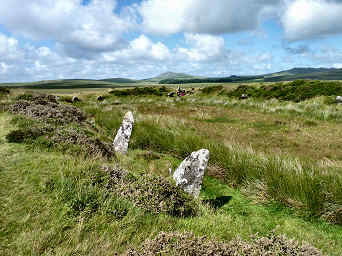
King Arthur's Hall - On OS109 at grid ref: 12963/77623
This is a very puzzling site. There is a rectangular enclosure bank, over six feet high in places and some 160 feet by 65 feet. The inside is lined with apparently random stones, upright, angled or lying flat. Romantics would have us believe that the enclosure was once roofed, hence its name, but its sheer size makes that most unlikely. Its age is a puzzle; its existence was first recorded in 1584 when it was apparently already known as King Arthur’s Hall. According to Craig Weatherhill, in his Cornovia, it could date from the Neolithic period, as do similar enclosures in Ireland and Wales. Some have suggested that it could simply be a cattle enclosure but its interior wetness makes that unlikely. It is noticeable that inside the bank and stones is a well defined rectangle of mares tail grass, inside that a rectangle of cotton grass. This suggests a lining of some sort that holds the moisture. Could it just be that it was a man-made pond or even reservoir to water the cattle on the moor or provide a water source for settlements nearby. Whatever its purpose, the sheer size suggests a place of some importance. It still feels like a special place, perhaps because of its location. Despite nearby farms and villages, you feel total isolation on the high moorland, your views of the higher land of Garrow Tor, Rough Tor and Brown Willy only heightening that feeling.
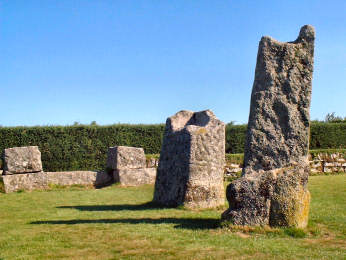
King Doniert's Stones
In a nicely maintained granite-walled enclosure, on the minor road between Doublebois and Minions, are a couple of granite standing stones, with handy car parking by the site. It is unclear whether they were always two or whether they are one broken in two. You will find it impossible to read the inscription carved in the granite but a plaque nearby carries the information: 'King Doniert's Stone. Men Myghtern Doniert. These two granite cross bases (if they are indeed separate) are decorated in the late Ninth Century style and probably date from that time. The shorter stone carries a Latin inscription "Doniert Progant Pro Anima", saying "Doniert ordered [this cross] for [the good of] his soul". Doniert was probably Durngarth, King of Cornwall who was drowned in AD875. The two stones have rectangular sockets on their top and probably carried wooden crosses'. Durngarth apparently drowned in the River Fowey near Draynes Bridge (a mile west), possibly at scenic Golitha Falls, reviewed on my 'Countryside' pages. Other sites to visit around Minions include Trethevy Quoit, the Hurlers and Pipers stones and Stowe's Hill. It is also well worth following a quiet signposted footpath along the old mineral tramway south towards the village of Crow's Nest to find the gaunt ruins of South Caradon Mine and the pleasant Crow's Nest Inn, where we have enjoyed many a hot baguette.
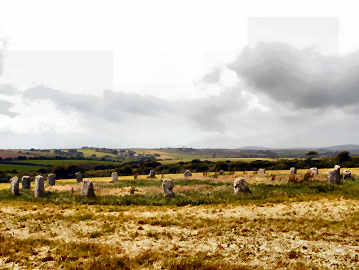
Lamorna - the area to the west of the village
Ever since December 2003, when my sister Mary and I did a round walk from Lamorna that included coast, Boskenna Cross and the Merry Maidens, I had been meaning to return to find the many other antiquities in the area. At last, in July 2007, I did it. After an early lunch at the Lamorna Wink Inn I left my car in their car park (with permission) and set out up the hill opposite to a path that took me west past three farms - Tregurnow, Rosemodress and Tregiffian - then north-west to Boscawen Ros Farm, the original home of the Falmouth's of Tregothnan. There I found my first standing stone in the middle of a field. Continuing north-west I found Boskenna Cross on the main road, then on up a lane to Moorcroft Cross. From there by a path south-west from Choone Farm for massive Goon Rith standing stone. On to the main road for Tregiffian Long Barrow (the cup marked stone is a concrete copy of the original in the Royal Cornwall Museum), then another cross, the Pipers standing stones and Merry Maidens stone circle, one of Cornwall's most complete with 19 regularly placed stones. Oddly, you cannot see one Piper from the other and you can't see the Merry Maidens from either, despite proximity. Yet you can see the Maidens from Goon Rith standing stone. Around 6 miles and very enjoyable.