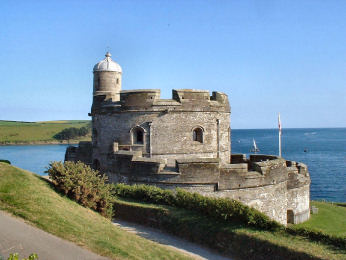
St. Mawes Castle
After Henry VIII broke with the Church of Rome in the 1530s and established his own Church of England, he found himself threatened by the Catholic powers in Europe. Henry's reaction was to strengthen his coastal defences. Predictably he strengthened the Tower of London and Dover Castle with great artillery bastions and built new forts protecting harbours at Deal and Walmer in Kent, Yarmouth on the Isle of Wight and Southsea by Portsmouth. All these were to protect London but he was also concerned about his first line of defence, the western harbours. In Cornwall his main concerns were Fowey, which had been providing fighting ships since the time of King Edward I, and Falmouth, Europe's largest deep-water harbour. At Fowey Henry linked two forts with a protective chain across the estuary. At Falmouth, where the estuary is more than a mile wide and chains would have been impossible, he built forts on Pendennis Head and on high ground at St. Mawes; their combined artillery fire-power provided full protection. At first glance St. Mawes Castle appears tiny, just a round tower and encircling wall. It is only when you get close that you spot the size and the clover leaf of artillery bastions. It speaks volumes for the expertise of Henry's engineers that St. Mawes and Pendennis were still capable of being garrisoned in both world wars. If visiting St. Mawes and Pendennis, why not use the Falmouth-St. Mawes ferry.
St. Mawes Castle
The castle is on the western of two roads into St. Mawes
More in Castles
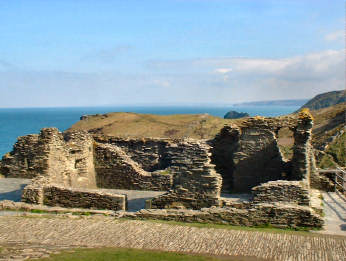
Tintagel Castle
Legend names Tintagel Castle as home of Igerne, Duchess of Cornwall and mother of King Arthur. Certainly the site was occupied in the 5th and 6th centuries. The 1998 discovery of a 6th century slate engraved with the word ‘Artognov’ might be thought to give some credence to Arthurian claims; and early graves by Tintagel Church are thought to be of the 6th century. Once the whole site would have been on an intact headland but the action of wind and waves over the centuries has almost detached part of the site. Major remains, on the ‘Island’ and mainland, are of a late Norman castle built by Richard Earl of Cornwall. Above are the 6th century remains, uncovered by nature following fire and storms in the 1980s. The ‘Island’ rises to 250 feet; one climbs to that height three times, so bring strong shoes and stamina - but it is worth it for the history, for the atmosphere and for the views. During the summer there is transport from the nearest car park, otherwise it is a long walk down - and a steep one back. We prefer to approach from St. Materiana's church, walking along Glebe Cliff and enjoying the impressive views along the coast. We used to think the village Cornwall's worst tourist trap; our views have changed more than a little and we are more pro-Tintagel now. For our updated view go to Tintagel on my Towns and Villages page. In August 2019 a bridge opebned conneting the castle direct with the mainland.
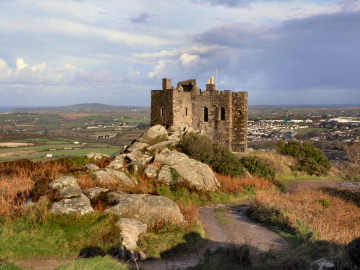
Carn Brea Castle
Brea Castle
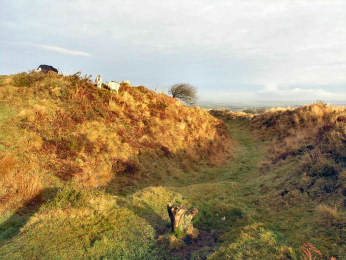
Castle-an-Dinas near St. Columb Major
Dinas near St. Columb Major