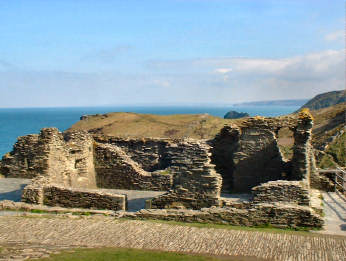
Tintagel Castle
Legend names Tintagel Castle as home of Igerne, Duchess of Cornwall and mother of King Arthur. Certainly the site was occupied in the 5th and 6th centuries. The 1998 discovery of a 6th century slate engraved with the word ‘Artognov’ might be thought to give some credence to Arthurian claims; and early graves by Tintagel Church are thought to be of the 6th century. Once the whole site would have been on an intact headland but the action of wind and waves over the centuries has almost detached part of the site. Major remains, on the ‘Island’ and mainland, are of a late Norman castle built by Richard Earl of Cornwall. Above are the 6th century remains, uncovered by nature following fire and storms in the 1980s. The ‘Island’ rises to 250 feet; one climbs to that height three times, so bring strong shoes and stamina - but it is worth it for the history, for the atmosphere and for the views. During the summer there is transport from the nearest car park, otherwise it is a long walk down - and a steep one back. We prefer to approach from St. Materiana's church, walking along Glebe Cliff and enjoying the impressive views along the coast. We used to think the village Cornwall's worst tourist trap; our views have changed more than a little and we are more pro-Tintagel now. For our updated view go to Tintagel on my Towns and Villages page. In August 2019 a bridge opebned conneting the castle direct with the mainland.
Ample parking in village - long walk. Castle revisited
14th century Great Hall of Tintagel Castle
I was last up on Tintagel Island in - I think - 2006. The years have made a lot of difference to my ability to cope with steps. In 2006 I thought nothing of climbing and descending 3 or 4 hundred steps. Then I was 68. Now, ten years later, at 78 I found this expedition very hard work and several days later my thigh muscles are still suffering! However, I had read abour the Gallos sculpture being installed on the top of the Island and, a few days later, at the beginning of May 2016, I made an expedition to see it. I parked, as I do for this part of the coast, by St. Materiana's church and approached the castle by the upper entrance. It was quite hard going, navigating the Island, not just on account of all the steps but also because of the large number of visitors there. The Gallos sculpture, an eight foot high bronze by Welshman Rubin Eynon, is said to represent power. Eynon is known for his public works, such as gates at Caerphilly Castle and the Bishops Palace at St. Davids. I greatly liked the statue, halfway between abstract and representational; it photographs well, best looking south to Gull Rock. After struggling back down again, I enjoyed a good coffee at the caf�, overlooking Tintagel Haven, then took the Land Rover up to the village, so as to take the easy walk back to the church by the Old Vicarage, its dovecot and unexpected little Fontevreaux Chapel.
In August 2019 a bridge opened conneting castle direct with mainland.
The Gallos sculpture on Tintagel Island
CORNWALL
Photographs
More in Castles
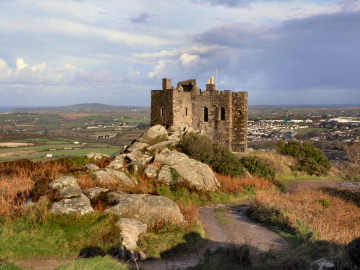
Carn Brea Castle
Brea Castle
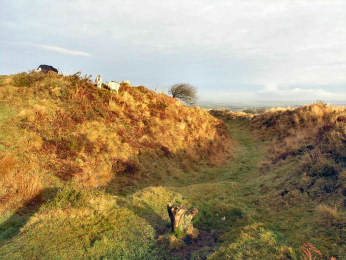
Castle-an-Dinas near St. Columb Major
Dinas near St. Columb Major
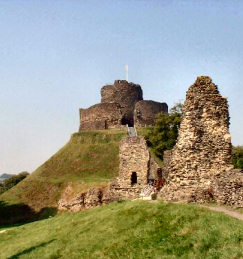
Launceston Castle
One of the earliest Norman castles, the original timber building was constructed for William the Conqueror’s brother Robert of Mortain. In the 13th century it was rebuilt in stone by Richard Earl of Cornwall, brother of Henry III. Unlike many castles, Launceston began to lose its importance early and ended as a prison – George Fox, founder of the Quakers, and with Cornish connections, was imprisoned there in 1655. Once the castle was of impressive size; now the only major structure standing is the round central keep, high on its motte. When you enter by the South Gate, you get some feeling for the original size of the castle and its once massive defences. From the keep parapet, the view of the town tells how it was once totally dominated by its castle, as therefore was the approach to Cornwall. English Heritage has good explanatory displays. Car parking nearby. You can walk freely in the park but pay for entry to the castle.