Launceston
, St. Mary Magdalene's Church
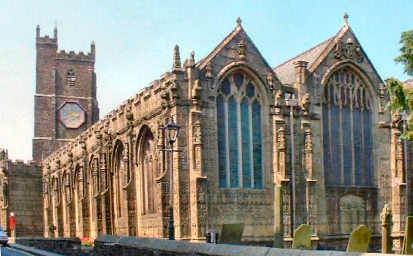
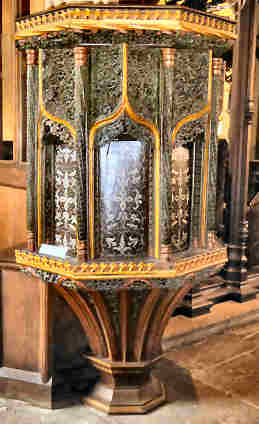
With so grand a church at its heart, you would expect that the present Launceston town would be the original settlement. However, the name Launceston is a corruption of Lan Stephan, still applied to the earlier settlement on the north side of the valley of the River Kensey - and the suburb's church, dedicated to St. Stephen, is itself quite grand - but too often closed. Of St. Mary Magdalene's church in modern Launceston, the exterior is the significant part; only the 15th century painted pulpit truly stands out inside. Rebuilt in the early 16th century the exterior is a monument to the great skills of Cornish stone carvers. Nothing is more difficult to work than granite, yet the whole is covered in elaborate decoration, the south porch most of all; motifs include quatrefoils, flowers, Latin mottoes, the arms of Sir Henry Trecarrel and his wife, the Duke of Cornwall's feathers, figures of St. George and the dragon, of St. Martin of Tours and a figure of Mary Magdalene carved not in stone but terracotta. A church well worth seeing, most of all for its superb exterior.
The off-axis tower is earlier than the body of the church
Launceston St. Mary Magdalene revisited - interior
Review of Launceston Town
Review of Launceston Castle
More in Churches & Holy Sites
Launceston
, St. Mary Magdalene's Church - the interior
Lelant
, St. Uny
Lesnewth
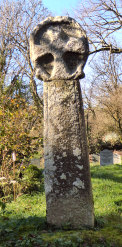
After revisiting St. Juliot's church with its Thomas Hardy associations, I went on to nearby Lesnewth. The name is a corruption of Lys Noweth or New Court. The village is but a hamlet with church, Old Rectory, Coach House, two farms and a few cottages. What I hadn't expected was to find a large Cornish Cross, its head a nicely cut wheel-cross. The church consists of three stage, pinnacled tower, nave, chancel and a vestry in the form of a double south transept. In the nave there are reported to be stained glass roundels (2003) by Caroline Henderson. I only noticed one, that of a bird on a twig, crosses on a hill in the background. On a wall an entertaining board records a grant from the "Incorporated Society for Building Churches". Elsewhere a slate memorial slab of 1680 carries an elaborate coat of arms. Pevsner says that in the porch are a Cornish wheel-head cross and a C13 grave slab with an incised foliated cross. I returned to check but I am afraid Pevsner is mistaken.