Serpentine - The Lizard's Unique (to England) and Colourful Rock
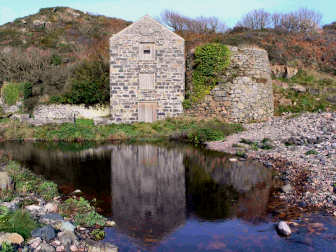
To give it its full geological name, serpentinised mantle peridodites is found nowhere else in England, only on the east coast of the far-flung Lizard Peninsula between Landewadnack Church Cove and Coverack. It really shouldn't be here at all as it's part of the earth's mantle and ought to be some 10 miles below the surface. Be that as it may, it was once the source of a major Cornish industry and still flourishes on a small scale. It was a visit to Cornwall in 1846 by Queen Victoria and Prince Albert that started the craze for Serpentine. The dark green rock, with its blue and red veins, polishes like marble to a wonderful deep sheen. It was much used for architectural and decorative features and for monumental masonry. Sadly, it does not weather well and those uses have died out. However, it is still worked for small decorative objects - a favourite is the miniature lighthouse; half the shops in Lizard Town stock them. The biggest Serpentine Works was in Carleon Cove just below Poltesco. The old pilchard cellars there were extended and converted for the purpose. What remains now is a warehouse and the round pilchard boat capstan house. It is a charming and tranquil cove accessible only from Poltesco or from the coast path north of Cadgwith. Rocks on the beach are massive.
Warehouse and Capstan House in Carleon Cove