Tolgus Tin - an updated entry - September 2012
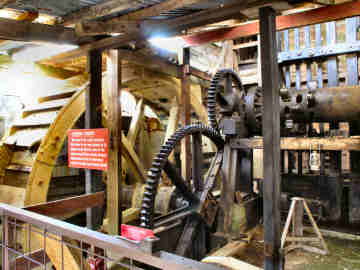
A fascinating place with an interesting history, now fulfilling its great potential. It is on Treasure Park on the Redruth to Portreath road; don't be put off by the very touristy aspects of Treasure Park itself. Tin has been streamed here for centuries, taking advantage of waste washed down from the Redruth area. The present tin-streaming works, Tolgus Tin, was started in the 1860s by the Uren brothers and continued operating on the site until the the 1980s when the price of tin collapsed. It was acquired by Cornish Goldsmiths as a tourist venue. The Trevithick Trust operated Tolgus Tin as a fascinating museum for a while but, when the Trust was wound up, the site became a little neglected. Now miner Graham Williams and a young colleague Rob, with good support from Treasure Park, are working hard to restore Tolgus as a working museum. Since late 2010 a vast amount of machinery has been restored, including the Cornish Stamps, one of only two still working. The site has come to the point where the tin ore can now be refined to quite a high degree of purity. Now a fascinating place, well worth visiting. Redruth Old Cornwall Society Town Museum is also here. You should also consider the superb King Edward Mine museum near Troon with its working mill machinery. More info on the Cornwall Gold web site. I wish Graham all the very best with his continuing most valuable work.
Cornish stamps and the waterwheel that powersd it
Treasure Park, signed from A30 at Redruth. Open Apr - Oct
More in Museums & Galleries
Trevithick Day in Camborne
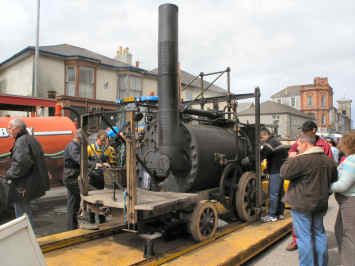
We would have gone to Trevithick Day in Camborne in 2005 but the steam parade had been cancelled for 'health and safety' reasons. Happily, such nonsense didn't happen in April 2006 so we went then. From early morning to late afternoon the central streets were closed to traffic. The Camborne Town Band led dancers through the town; a static steam traction engine display later trundled smokily throught the streets; in Town Square we were treated to a pipe and drum band, the Holman Climax Choir, the Praze and Hayle Male Voice Choir, a circus clown, a saxophone quartet and a samba band. We also saw a rousing steel band, fairground organs, vintage fire engines, classic cars, military vehicles and a Punch and Judy show. The parades of traction engines and their miniatures were the true highlights but our small personal highlight was sitting in Town Square, eating Rowe's fine pasties whilst enjoying multi-instrumentalist Graham Hart playing and singing his rousing version of 'Going up Camborne Hill, coming down' - which commemorates the first trial of Trevithick's 1801 Puffing Devil road loco, which the crowd of fascinated spectators thought was going backwards. A great day - both for steam and Trevithick enthusiasts and for the folk of Camborne. We shall go again.
UNESCO World Heritage Status for Cornwall and West Devon Mines
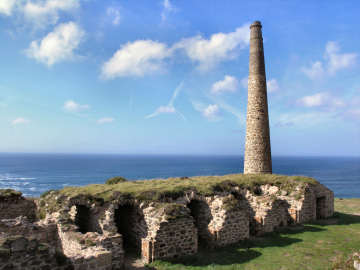
World Heritage Status for Cornwall and West Devon Mines
Upton Towans at Hayle
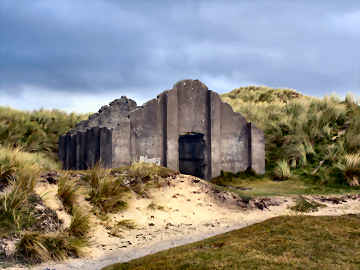
At the end of Sepember 2007 I did a walk from Godrevy National Trust car park - busy with surfers - to Hayle and back to investigate Upton Towans to see how much I could find of its former industry, the National Explosive Works. I was surprised by just how much I found. The National Exposive Works, which gave the dunes their alternative name of 'Dynamite Towans', opened in 1888 to make dynamite for the Cornish mines. It continued in operation until around 1920, latterly producing explosives for the First World War. To my surprise explosives were still stored on the site until the 1960s. At first I thought that all I would see was several protective bunkers near the sea where, presumably, testing took place. But, when I made my way towards the tall brick chimney by the Hayle to Gwithian road, I passed quite a number of abandoned buildings and skeletal ruins. By the chimney were even more substantial remains, including what must have been a very large brick building. This was clearly a vast works and indeed once employed 1500 workers. Elsewhere on Upton Towans I found some of 30 odd capped mine shafts - one on Gwithian Towans too - as well as WWII pillboxes and bunkers. While at Hayle I also sought out the power station, operating from 1910 to 1977. At its closure the once busy harbour, which had imported the coal, also closed.