The Marconi Centre at Poldhu Point on the Lizard Peninsula
Marconi Centre at Poldhu Point on the Lizard Peninsula
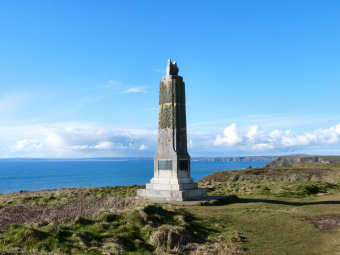
Sadly, Marconi's second (but most famous) Cornish Wireless Station, from which he made the historic radio transmission to St. John's in Newfoundland in 1901, no longer exists, although the bases of the huts, in front of the former Poldhu Cove Hotel, are preserved as of great historic and archaeological importance. Gugliegmo Marconi chose this site - for his first transmissions to Ireland and Newfoundland and for much later work - because of its westerly location, its freedom from obstruction and for the convenience of the Poldhu Hotel to house his workforce.The Poldhu Hotel may now be a care home and Marconi's buildings may have gone, except for foundations, but the combined efforts of the Poldhu Amateur Radio Club, the National Trust and the Marconi Company resulted in a permanent Marconi Centre Museum opening at Poldhu Point in 2004. Essentially, the Marconi Centre is home to the Poldhu Amateur Radio Club, an entirely appropriate use for so historic a site. In the field behind the centre you can see the foundations of Marconi's buildings and a levelled circle where aerial arrays stood. Nearby an earlier monument stands on the clifftop, commemorating Marconi's feat. Centre opening times, found on their web site, are a bit odd and there is an uphill walk from a car park.
From Mullion follow Poldhu Cove signs, car park behind beach
Marconi Memorial at Poldhu Point, lovely morning
Links: Marconi Centre Poldhu website
More in Museums & Galleries
Tolgus Tin - an updated entry - September 2012
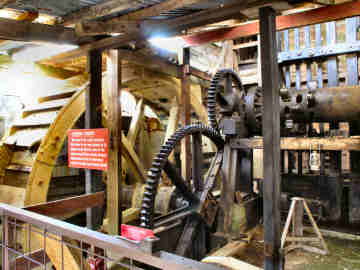
A fascinating place with an interesting history, now fulfilling its great potential. It is on Treasure Park on the Redruth to Portreath road; don't be put off by the very touristy aspects of Treasure Park itself. Tin has been streamed here for centuries, taking advantage of waste washed down from the Redruth area. The present tin-streaming works, Tolgus Tin, was started in the 1860s by the Uren brothers and continued operating on the site until the the 1980s when the price of tin collapsed. It was acquired by Cornish Goldsmiths as a tourist venue. The Trevithick Trust operated Tolgus Tin as a fascinating museum for a while but, when the Trust was wound up, the site became a little neglected. Now miner Graham Williams and a young colleague Rob, with good support from Treasure Park, are working hard to restore Tolgus as a working museum. Since late 2010 a vast amount of machinery has been restored, including the Cornish Stamps, one of only two still working. The site has come to the point where the tin ore can now be refined to quite a high degree of purity. Now a fascinating place, well worth visiting. Redruth Old Cornwall Society Town Museum is also here. You should also consider the superb King Edward Mine museum near Troon with its working mill machinery. More info on the Cornwall Gold web site. I wish Graham all the very best with his continuing most valuable work.
Trevithick Day in Camborne
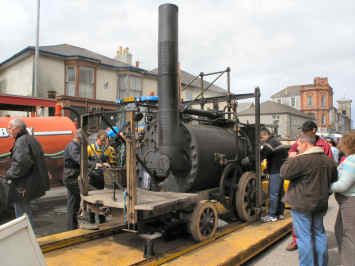
We would have gone to Trevithick Day in Camborne in 2005 but the steam parade had been cancelled for 'health and safety' reasons. Happily, such nonsense didn't happen in April 2006 so we went then. From early morning to late afternoon the central streets were closed to traffic. The Camborne Town Band led dancers through the town; a static steam traction engine display later trundled smokily throught the streets; in Town Square we were treated to a pipe and drum band, the Holman Climax Choir, the Praze and Hayle Male Voice Choir, a circus clown, a saxophone quartet and a samba band. We also saw a rousing steel band, fairground organs, vintage fire engines, classic cars, military vehicles and a Punch and Judy show. The parades of traction engines and their miniatures were the true highlights but our small personal highlight was sitting in Town Square, eating Rowe's fine pasties whilst enjoying multi-instrumentalist Graham Hart playing and singing his rousing version of 'Going up Camborne Hill, coming down' - which commemorates the first trial of Trevithick's 1801 Puffing Devil road loco, which the crowd of fascinated spectators thought was going backwards. A great day - both for steam and Trevithick enthusiasts and for the folk of Camborne. We shall go again.
UNESCO World Heritage Status for Cornwall and West Devon Mines
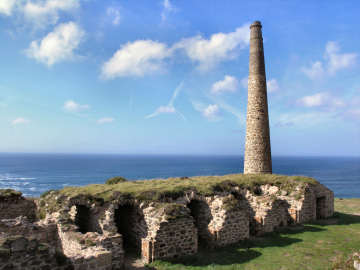
World Heritage Status for Cornwall and West Devon Mines