Trevithick Day in Camborne
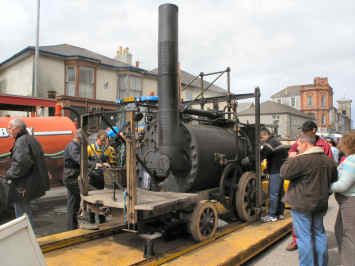
We would have gone to Trevithick Day in Camborne in 2005 but the steam parade had been cancelled for 'health and safety' reasons. Happily, such nonsense didn't happen in April 2006 so we went then. From early morning to late afternoon the central streets were closed to traffic. The Camborne Town Band led dancers through the town; a static steam traction engine display later trundled smokily throught the streets; in Town Square we were treated to a pipe and drum band, the Holman Climax Choir, the Praze and Hayle Male Voice Choir, a circus clown, a saxophone quartet and a samba band. We also saw a rousing steel band, fairground organs, vintage fire engines, classic cars, military vehicles and a Punch and Judy show. The parades of traction engines and their miniatures were the true highlights but our small personal highlight was sitting in Town Square, eating Rowe's fine pasties whilst enjoying multi-instrumentalist Graham Hart playing and singing his rousing version of 'Going up Camborne Hill, coming down' - which commemorates the first trial of Trevithick's 1801 Puffing Devil road loco, which the crowd of fascinated spectators thought was going backwards. A great day - both for steam and Trevithick enthusiasts and for the folk of Camborne. We shall go again.
Photo from Trevithick Day - Captain Dick's Puffer replica
Replica of Trevithick's 1801 Camborne Road Loco
More in Museums & Galleries
UNESCO World Heritage Status for Cornwall and West Devon Mines
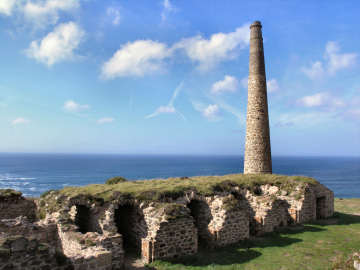
World Heritage Status for Cornwall and West Devon Mines
Upton Towans at Hayle
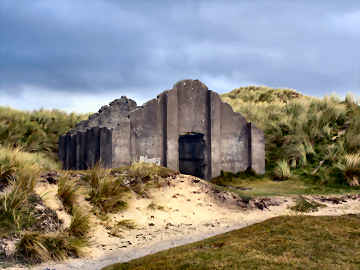
At the end of Sepember 2007 I did a walk from Godrevy National Trust car park - busy with surfers - to Hayle and back to investigate Upton Towans to see how much I could find of its former industry, the National Explosive Works. I was surprised by just how much I found. The National Exposive Works, which gave the dunes their alternative name of 'Dynamite Towans', opened in 1888 to make dynamite for the Cornish mines. It continued in operation until around 1920, latterly producing explosives for the First World War. To my surprise explosives were still stored on the site until the 1960s. At first I thought that all I would see was several protective bunkers near the sea where, presumably, testing took place. But, when I made my way towards the tall brick chimney by the Hayle to Gwithian road, I passed quite a number of abandoned buildings and skeletal ruins. By the chimney were even more substantial remains, including what must have been a very large brick building. This was clearly a vast works and indeed once employed 1500 workers. Elsewhere on Upton Towans I found some of 30 odd capped mine shafts - one on Gwithian Towans too - as well as WWII pillboxes and bunkers. While at Hayle I also sought out the power station, operating from 1910 to 1977. At its closure the once busy harbour, which had imported the coal, also closed.
Wheal Martyn Museum of China Clay
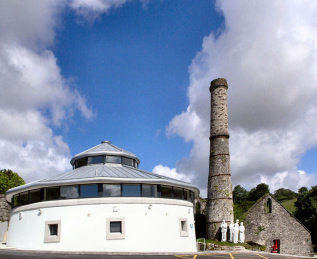
Cornwall’s tin-mining industry may be long gone with the collapse in the price of tin but, with the demand for kaolin for porcelain, paper, medical and many other applications, china clay production continues on a large scale north of St. Austell, amidst a strange ‘Mountains of the Moon’ landscape, known locally as the Cornish Alps. Wheal Martyn, a major working clay-pit, has restored its 19th century workings to create an important museum of one of Cornwall's most enduring industries. An excellent introductory exhibition tells the story of china clay and of Wheal Martyn. Informative exhibitions include displays of minerals, examples of local pottery and porcelain, the great Fal Valley Oil Engine, displays on the local brick-making industry, on the cooper’s art and on tools and transport equipment. An Historic Trail covers the old works; along the way you see two working waterwheels, one 18 foot, the other Cornwall's largest at 35 feet, slurry pumps, settling pits, tanks and kilns. The whole process of china clay production, from quarrying to the final product, is well explained. A well waymarked Nature Trail runs for over a mile and shows how nature has colonised old workings and spoil heaps; a platform above modern Wheal Martyn pit offers views of the present industry and a panorama of the Cornish Alps. The museum is signed from the Bodmin-St. Austell road and is not far from the Eden Project. There is a shop, a good caf� and ample parking.