UNESCO World Heritage Status for Cornwall and West Devon Mines
World Heritage Status for Cornwall and West Devon Mines
In 2006 many of the mining areas of Cornwall and West Devon were granted World Heritage Site status by UNESCO. As a result many projects have been completed to conserve - and improve public access to - what are considered to be the most important 'heritage' sites from the period 1700 to 1914. Ten areas selected for their mine sites, landscapes, towns and villages, include St. Just in Penwith, areas around Helston, Camborne, Redruth, St. Agnes, Luxulyan, Caradon and Devon Great Consols in the Tamar Valley around Tavistock. Also included are the ports of Hayle and Charlestown and historic Perran Foundry between Truro and Falmouth. As part of the improvement of access to these sites, Cornwall Council has created new Mining Trails to add to the previous Coast to Coast and Great Flat Lode trails. The new trails were finished in 2010 and include a Tehidy Trail, a Portreath Branchline Trail, a Redruth and Chacewater Railway Trail and a short Tresavean Trail to the south of Lanner. During 2006 and 2007 I explored what I could of the new routes. In 2010 I walked all the Mining Trails (formerly Mineral Tramways) in full. My detailed reports on them appear on my Trails pages.
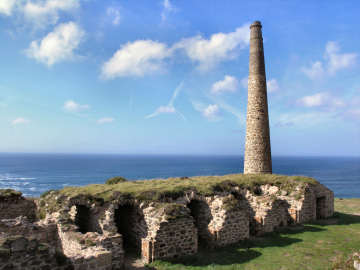
Botallack calciner and its tall chimneystack
Cornish Mining - Links to Mining Heritage and trails reports
Mining Heritage -
More in Museums & Galleries
Upton Towans at Hayle
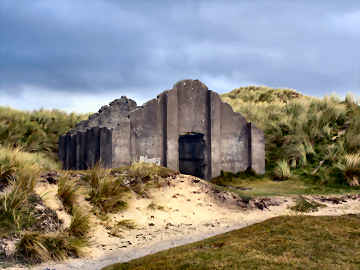
At the end of Sepember 2007 I did a walk from Godrevy National Trust car park - busy with surfers - to Hayle and back to investigate Upton Towans to see how much I could find of its former industry, the National Explosive Works. I was surprised by just how much I found. The National Exposive Works, which gave the dunes their alternative name of 'Dynamite Towans', opened in 1888 to make dynamite for the Cornish mines. It continued in operation until around 1920, latterly producing explosives for the First World War. To my surprise explosives were still stored on the site until the 1960s. At first I thought that all I would see was several protective bunkers near the sea where, presumably, testing took place. But, when I made my way towards the tall brick chimney by the Hayle to Gwithian road, I passed quite a number of abandoned buildings and skeletal ruins. By the chimney were even more substantial remains, including what must have been a very large brick building. This was clearly a vast works and indeed once employed 1500 workers. Elsewhere on Upton Towans I found some of 30 odd capped mine shafts - one on Gwithian Towans too - as well as WWII pillboxes and bunkers. While at Hayle I also sought out the power station, operating from 1910 to 1977. At its closure the once busy harbour, which had imported the coal, also closed.
Wheal Martyn Museum of China Clay
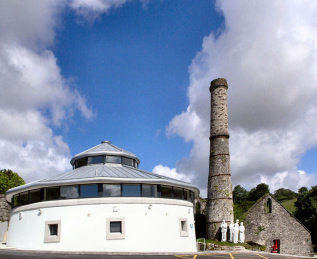
Cornwall’s tin-mining industry may be long gone with the collapse in the price of tin but, with the demand for kaolin for porcelain, paper, medical and many other applications, china clay production continues on a large scale north of St. Austell, amidst a strange ‘Mountains of the Moon’ landscape, known locally as the Cornish Alps. Wheal Martyn, a major working clay-pit, has restored its 19th century workings to create an important museum of one of Cornwall's most enduring industries. An excellent introductory exhibition tells the story of china clay and of Wheal Martyn. Informative exhibitions include displays of minerals, examples of local pottery and porcelain, the great Fal Valley Oil Engine, displays on the local brick-making industry, on the cooper’s art and on tools and transport equipment. An Historic Trail covers the old works; along the way you see two working waterwheels, one 18 foot, the other Cornwall's largest at 35 feet, slurry pumps, settling pits, tanks and kilns. The whole process of china clay production, from quarrying to the final product, is well explained. A well waymarked Nature Trail runs for over a mile and shows how nature has colonised old workings and spoil heaps; a platform above modern Wheal Martyn pit offers views of the present industry and a panorama of the Cornish Alps. The museum is signed from the Bodmin-St. Austell road and is not far from the Eden Project. There is a shop, a good caf� and ample parking.
Wheal Peevor at Radnor near Redruth
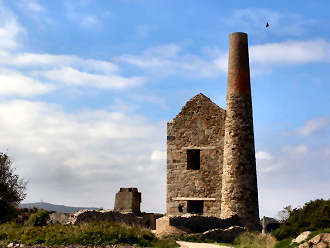
Peevor at Radnor near Redruth