More on Looe
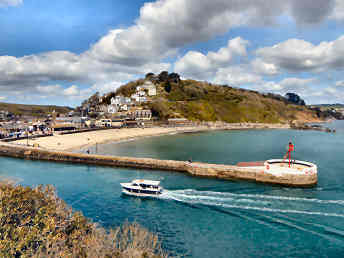
Since my original report on Looe, I have passed through it a few times, walking the Cornish Coast Path, but have not spent much time there. So, in early May 2016, Jane and I parked a the far end of Hannafore, walked round to West Looe, where we enjoyed a powerful coffee at Tasty Corner, a caf�/restaurant, new to us, with a view across to East Looe. We continued round, over the many-arched Looe Bridge and into East Looe. We wandered around the town, surprisingly busy with visitors though still very early in the season, and debated lunching in the Salutation Inn which we had enjoyed on our last visit, but decided to cross back to West Looe and eat at Tasty Corner. So we took the little ferry across the river - a little precarious getting on and off for us older folks - and enjoyed an excellent and reasonably priced lunch. Jane had a delicious and well filled crab sandwich while I had their fish and chips; fish, batter and chipe were all excellent. We walked back round to Hannafore, where we had hoped to get tea and coffee; unfortunately the kiosk was closed for some unknown reason. I realise that on most previous visits to Looe the tide has been out. This time the tide was in, the sun was out so, happily, I was able to get some decent photos.
Banjo Pier and Looe Beach
More in Towns & Villages

More Tintagel Images
The Bridge to the Island, opened 2019

More Trethevey
Trethevey
Morwenstow
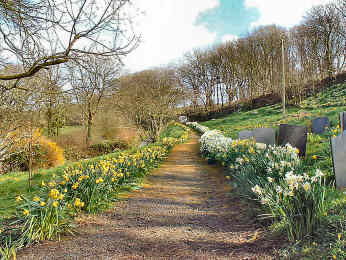
Comparatively inaccessible but definitely well worth going out of your way for, Morwenstow is Cornwall's most northerly parish; it is the 'holy place of St. Morwenna'. There are two tiny hamlets, Crosstown and Morwenstow. Crosstown is a collection of farms around a large village green, one incorporating a small pub, the Bush. Two tiny bars have half-a-dozen tables and a short, simple and inexpensive menu. A little further on towards the coast is Morwenstow Churchtown. Here are just a church, the former rectory, Rectory Farm, offering teas in summer, a couple of holy wells and Parson Hawker's famous Hut on the cliffs. In the churchyard are a Cornish cross, the figurehead from the 'Caledonia', wrecked off Higher Sharpnose Point, masses of daffodils in spring and, at the top, St. John's Well, accessed separately. A Norman doorway leads into a church with Norman arcading, a medieval fresco and some handsome carved bench ends. Most famous incumbent was Robert Stephen Hawker, vicar for 40 years from 1834.