
St. Dennis
Dennis
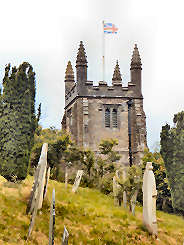
I was last at the church in St. Dennis in July 2008, having walked up on a path due south from Goss Moor. This time, in December 2016, I drove up to the church, high up a hill north of the village. My interest was the site itself, the church standing within an iron-age hill-fort, and in the Cornish Cross standing in what may be its original base close to the porch. On the other side of the porch, oddly, there is an old font, simply removed from the church when replaced and just dumped outside. Sadly, as so often, I was unable to gain access to the church though, since it was rebuilt in 1847, it is unlikely that mch original survives inside. A population of around 3,000 has St. Dennis hovering between village and town status. There is doubt as to whether the village, taking its name from the earlier church, is named for the early Italian Bishop Dionysius or whether it is a corruption of Dinas, the Cornish word for a hill-fort, the church standing within one, high above the village. In the 1940s, when the china clay industry was booming, St. Dennis boasted a War Memorial Club, Band Club, Football Club and the Plaza Cinema. In the 1960's it had a Co-op store, three mens hairdressers, a ladies hairdresser, four petrol filling stations and car repair workshops, two schools, two doctors surgeries, a chemist shop, fire station, blacksmith shop, coalyard, two pubs, cobblers shop, two fish and chip shops, two bakeries, two chapels, post office, undertaker, launderette and a furniture showroom.. With the contraction and mechanisation of the china clay industry, some of these businesses suffered and closed but St. Dennis remains an active community with a noteworthy town band..
Church weathervane
St. Denys church. Note the external tower stair turret
Churchyard Cornish Cross
St.
Photographs
More in Towns & Villages

St. Ewe
Ewe
St. Gennys
Gennys
St. Germans
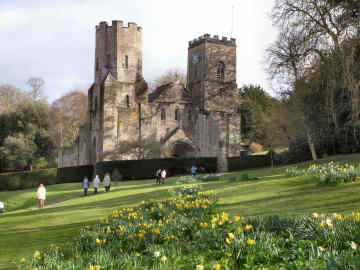
Tucked away, just off the main Liskeard to Plymouth road, on the tidal River Lynher - but with relatively little obvious access to the water - is the straggling village of St. Germans, once the estate village to Port Eliot house, stately home of the Earls of St. Germans. As you enter the village, you pass charming Tudor Moyles Almshouses with ambulatories on both floors but the real surprise is the church at the far end of the village. A cathedral in Saxon times, then an Augustinian priory under the Normans, its domestic buildings are now the heart of Port Eliot house. The church has two west towers, one square, one octagonal, and a superb Norman west door. Inside is glass by William Morris and Burne Jones and a grossly 'over-the-top' Eliot memorial by sculptor Rysbrack. Port Eliot house holds a literary festival in summer, proving to be more successful each passing summer. Until 2008 the house was not open to the public but, as a result of an inheritance tax gift in lieu, it is now open from March to mid-June. In addition to the house, with its John Soane rooms, its fine furniture and collection of Joshua Reynolds portraits, you can wander freely in 600 acres of gardens and grounds. The Eliot Arms pub looks attractive and claims fine food but, when we visited the house in March 2008, we had already eaten at the disappointing Crooked Spaniards at Cargreen.